

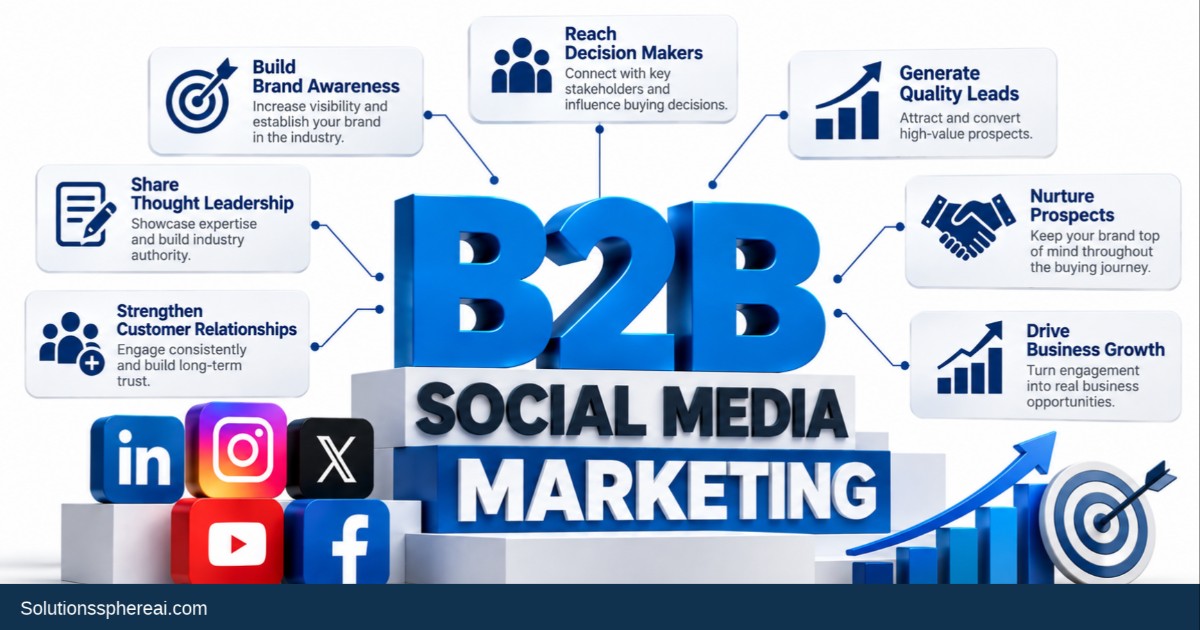
The goal for B2B companies should not be just to get likes, or followers. A winning social media strategy connects content, audience insights, brand positioning, lead generation and measurable business results. If you are a technology company, SaaS provider, manufacturer, professional service provider or enterprise solution company, social media can be a meaningful part of your demand-generation engine with the right strategy. Here are 10 B2B social media marketing strategies to help businesses build a stronger digital presence and promote sustainable growth.
1. Know Your B2B Audience Before You Start Creating Content
Great B2B social media marketing begins with a clear understanding of who you’re trying to reach. A broad audience creates impressions, but a well-defined audience makes it easier to create content that attracts the people most likely to become customers. When defining their target audience, B2B companies must consider industry, company size, job role, seniority, business challenges, purchasing authority and geographical location.
For example, a company selling enterprise cyber security solutions may have to address a Chief Information Security Officer, an IT manager, and a procurement professional differently. Different individuals may be involved in the same buying decision but with varying priorities. Audience personas help businesses develop more relevant content and increase quality of engagement. LinkedIn and other sites can then be used strategically to target professionals by job title, industry, company traits, and professional interests.
2. Create a Robust LinkedIn Content Strategy
LinkedIn is a fantastic platform for B2B businesses as it is centered around professional relationships, business talk, industry knowledge, and career networks. But posting company announcements alone won't do much to build a strong presence. Businesses should develop a structured LinkedIn content strategy that incorporates educational, informational, thought-leadership, promotional, and engagement-oriented content.
Rather than always promoting products or services, businesses can discuss industry developments, explain complicated ideas, share customer challenges, provide practical recommendations, and publish insights from their own expertise. Employee perspectives can bring authenticity to corporate content as well. By involving employees, subject-matter experts and company leadership to share content, businesses could potentially reach audiences outside of their company page. And if a company is producing consistent, valuable content over time, it can become a credible voice in its industry.
3. Create Content Around Customer Problems You Already Have
Good B2B social media content answers questions potential customers are already asking. The mistake many businesses make is to create content about what they want to sell rather than what their audience wants to understand. A better approach is to identify common customer problems and build content around them.
A manufacturing company, for example, might discuss production inefficiencies, equipment maintenance, supply-chain challenges or operational costs, rather than simply outlining its products. A digital marketing company might also create content about things like falling organic traffic, low-quality leads, technical SEO problems, or failed ad campaigns. This way, social media content is more useful for people since it connects the company's expertise with real business problems. When prospects receive helpful answers from a brand over and over again, they’re more familiar with the company when they finally enter an active buying cycle.
4. Leverage Thought Leadership to Build Industry Authority
Trust often underlies the decision in B2B purchases. Companies want to partner with businesses that know their industry and understand the challenges they face. So thought leadership can play a huge part in B2B social media marketing.
Thought leadership isn’t about making bold predictions or publishing lengthy reports. This could bring expert opinions on industry developments, analysis of emerging trends, lessons learned from projects, original observations, data-driven insights and practical frameworks. Company leaders and subject-matter experts can share their views on LinkedIn posts, articles, videos, interviews and webinars. The aim is to demonstrate expertise, not to constantly push a product.
A strong thought-leadership strategy can also support other digital marketing efforts. Social content can lead audiences to detailed blogs, case studies, whitepapers, landing pages, webinars, and other resources to build a connected ecosystem of content.
5. Repurpose Website Content Into Social Media Assets
Blogs, reports, case studies and other website content are often a huge time suck for B2B companies. But, once you’ve published an article, do not think that its marketing potential is exhausted. Businesses can take one big piece of content and repurpose it into multiple social media assets.
For example, a detailed blog can be divided into a number of LinkedIn posts, a carousel explaining key insights, short-form videos, statistics, quote graphics, discussion questions, or a longer thought-leadership post. With this approach, companies can increase the longevity of their content and keep channels consistent.
Repurposing also creates a better bridge between social media and SEO. Social posts can bring up a topic and let people visit the company’s website to learn more. Social media activity doesn’t replace SEO directly, but it can help with overall brand visibility, getting your content out there and getting your audience involved.
6. Social Media: Use for lead generation, not just awareness
Brand awareness is great, but ultimately B2B businesses need qualified opportunities. Social media strategies should therefore have clear pathways from engaging content to lead generation. This may include landing pages, downloadable resources, webinars, consultation forms, demo requests, newsletters or other conversion opportunities.
The trick is to match your offer to the prospect’s buying journey stage. A new company discoverer might be more interested in an educational guide than a sales consultation. Someone who has already interacted with a few pieces of content might be more open to a case study or a product demo. By matching content with the right calls to action, companies can move prospects progressively through the stages of awareness, consideration, and conversion. A B2B social media agency combines content strategy, audience targeting, and performance tracking to support long-term business growth.
7. Integrating Organic Social Media with Paid Campaigns
Organic content and paid social advertising can work together to make a more complete B2B marketing strategy. Organic content builds credibility and keeps regular visibility, while paid campaigns can help businesses reach specific professional audiences and promote high-value content or conversion offers.
For example, you can use LinkedIn advertising to target professional audiences and Google Ads to reach users actively searching for relevant solutions. But the best way isn’t necessarily to treat paid advertising as a separate activity. Alternatively, businesses can use organic content to discover what topics are driving engagement and then develop paid campaigns around relevant offers and audiences.
8. Case Studies and Customer Proof
B2B buyers are looking for proof that a solution can deliver real business results. So, case studies, testimonials, project results and customer stories can be powerful elements of a social media strategy.
Rather than just stating that a product or service works, businesses can describe the customer’s original problem, the solution they implemented, the approach they took and, if possible, the measurable result. Though companies may not be able to give exact numbers due to confidentiality, they can still talk about the problem and how they solved it. Customer proof reduces uncertainty and provides prospects with a better understanding of how the company’s expertise can be applied to their own situation.
9. Employ Metrics That Relate Social Media to Business Goals
You want to measure a B2B social media strategy against meaningful objectives — not vanity metrics. Follower growth and impressions can provide useful context, but they don’t necessarily show business impact.
Companies should measure success by: engagement from relevant professionals, website traffic, content downloads, leads generated, landing-page conversions, cost per lead, audience growth within target segments and assisted conversions. Businesses should also analyze which content themes drive meaningful engagement and which channels drive qualified opportunities. This data can then be used to optimize content, targeting, advertising spend, and conversion strategies.
10. Be Consistent Throughout the Entire B2B Marketing Funnel
And B2B social media doesn’t work in a silo from SEO, performance marketing, email marketing, content marketing and sales. The best strategies combine these activities into one customer journey.
A prospect could be introduced to a company via a LinkedIn post, visit the website, read a blog, look for the company’s services at some later point, interact with a paid ad, download a resource, and eventually talk to the sales team. Every touch is part of the overall buying journey. That’s why companies need to maintain consistent messaging, positioning and calls to action across their digital channels.
Consistency also means having a realistic publishing schedule. Rather than posting heavy for a few weeks and then going dark, businesses should develop a sustainable content calendar. Regular publishing, performance analysis, experimentation and refinement over time can be effective in building momentum. With the right strategy, social media marketing for B2B companies can support lead generation while building long-term relationships with potential customers.
How SSAI can Help
B2B social media marketing is not simply about having a presence on LinkedIn or posting occasional company updates. Audience research, valuable content, thought leadership, lead generation, paid campaigns, customer proof, and performance measurement — when combined, it can be a strategic growth channel for businesses. The best approach is one that connects social media activity to the bigger business objectives and the entire B2B buying journey.
At some point, businesses trying to improve their digital footprint should move beyond asking, “How many people saw our post?” Instead, they should be asking, “Did our content reach the right audience? Did it build trust? Did it create meaningful engagement? Did it help create business opportunities?”
If you are a business looking to build an integrated digital strategy, SolutionsSphereAi a B2B Digital Marketing Agency Bengaluru can help connect B2B social media, SEO, content, and performance marketing into a more structured digital growth approach.