

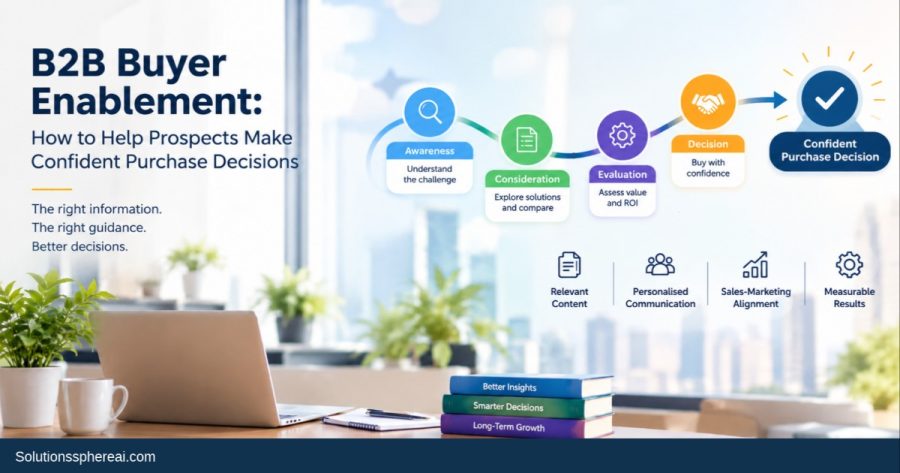
Understanding the Complexity of B2B Purchasing Decisions
B2B purchasing decisions are seldom simple. Business buyers also differ from individual consumers in that they often operate within complex decision-making structures involving multiple stakeholders, budget approvals, technical evaluations, and long-term business considerations. A seemingly simple purchase may involve input from marketing teams, finance departments, IT professionals, procurement managers and senior leadership. Different stakeholders may have different priorities and expectations, which can make the buying process longer and more complicated.
It’s an important opportunity for businesses. Instead of bombarding prospects with promotional messages, companies can build trust by making the decision-making process easier. If buyers have access to timely insights, transparent information and practical resources, they are more likely to understand the value of a solution and rationalize their investment. Great buyer enablement bridges the gap between creating interest and empowering prospects to buy with confidence.
Why B2B Buyer Enablement Is Important
B2B buyer enablement is the process of equipping potential customers with the knowledge, tools and resources to make informed purchasing decisions. It's about cutting through the confusion, addressing concerns, and helping stakeholders understand how a given product or service can solve their business challenges. Traditional marketing is about creating awareness and demand, while buyer enablement is more about making it easy for the prospect to buy.
One of the key difficulties in B2B sales is that purchasers have difficulty assessing complex solutions. They may know their business problem, but not have the technical or industry knowledge to know how best to solve it. In other cases, disagreements among different stakeholders may arise concerning priorities, expected results, or available budgets. Without reliable info, these discussions can slow down decision making or cause potential customers to walk away from the buying process.
Buyer enablement solves this by providing critical information at each step of the journey. Prospects can use educational blogs, detailed product descriptions, comparison guides, case studies, implementation resources and clear pricing information to work out their options. By consistently offering valuable information, as opposed to simply pitching sales, businesses build credibility and become more valuable partners in the buyer’s decision-making process.
Understanding the Modern B2B Buying Journey
The modern B2B buying journey is seldom a linear process. Prospects are often bouncing back and forth between researching solutions, talking to peers, comparing vendors, reviewing their requirements, and assessing business outcomes. They might visit a company’s website, read industry publications, attend webinars, review LinkedIn content and talk to sales reps before they make a final decision.
This behavior means it’s important for businesses to understand what buyers want at each stage of their journey. During the awareness stage, prospects are mainly concerned with comprehending their challenges and finding possible solutions Informative articles, industry reports and educational resources can help them to identify problems they may not have been fully aware of.
At the consideration stage, buyers start to weigh up different approaches, and compare potential service providers. Needs more detailed information on capabilities, processes, pricing, benefits and implementation requirements. Articles that compare products, solution guides, demos and customer success stories are especially valuable.
The decision stage requires prospects to have evidence to back up their final choice. “What’s the ROI?” “What are the timelines for implementation?” “What’s the ongoing support?” “What’s the business impact?” Detailed case studies, proposals, testimonials and clear answers to technical or commercial questions can help you overcome the final barriers to conversion.
By knowing these stages, businesses can send relevant information rather than sending the same marketing message to every prospect.
Case Studies: Show the Real Value to Business
One of the best ways to get prospects feeling confident about their buying decisions is to show them how a solution has worked for other businesses. Product descriptions are all well and good, but case studies tell you how the products actually perform in the real world.
B2B buyers are naturally cautious about investments because purchase decisions can impact operational efficiency, revenue, productivity and long-term business performance. They want to see proof that the proposed solution can deliver measurable value, not just marketing promises. Case studies help close this gap by showing the real-world business problem, the solution that was put in place and the results that were achieved.
A good case study will contain the customer’s initial problem, the approach, the implementation and the measurable results as far as reliable data is available. To make results more meaningful, metrics like decreased operating costs, better lead generation, higher conversion rates, reduced processing times or increased productivity can be used.
.
Sales Enablement Tools to Make Complex Information Easy
Even if a company produces valuable content, prospects can have difficulty connecting the dots between different pieces of information and assessing their options. That’s where sales enablement resources come in. These resources help sales teams consistently communicate value and also give buyers the information they need to evaluate a solution on their own.
A complex purchasing decision can be made easier by comparison sheets, product brochures, pricing explanations, implementation timelines, technical documentation, ROI calculators and demonstration videos. Instead of asking prospects to pull information from several different places, businesses can bring important details together into usable resources.
For example, a ROI calculator can let prospects calculate potential financial benefits based on their business needs. A comparison guide can help to clarify the differences between the solutions on offer and an implementation document can help to explain what happens once a purchase is complete.
Tailor Communications to Buyer Needs
Not all B2B prospects have the same goals, pain points or expectations. A startup wanting to implement its first marketing automation platform might have entirely different needs than an established enterprise wanting to upgrade its current technology infrastructure. Marketing efforts may be less effective when both audiences receive the same communication.
Buyer enablement is more relevant for businesses with personalization. This allows marketing and sales teams to learn about a prospect’s industry, company size, business challenges, past interactions, and purchasing interests so that they can share information that matches their needs.
Customer relationship management (CRM) platforms and marketing automation tools can help companies organize prospect information and identify engagement patterns. For example, a prospect who is repeatedly exploring technical documentation may need detailed product information, while someone downloading pricing guides may be closer to a purchasing decision.
Artificial intelligence can help this process by looking at interactions with customers, finding patterns and helping marketing teams suggest related content. But personalization should always be about adding real value, not just about sending more targeted promotional messages. The goal is to make each interaction more useful and relevant for the purchaser.
Aligning Sales and Marketing Teams Around Buyer Needs
Close collaboration between sales and marketing teams is key to effective buyer enablement. If these departments aren’t aligned, prospects can receive mixed messages, hear the same story over and over again, or get content that doesn’t address their real needs.
Marketing teams know audience behavior, content engagement and lead generation, and the sales teams know customer objections, purchase expectations and decision-making challenges. Combining these perspectives helps companies develop a more effective buyer enablement strategy.
For example, sales reps can share frequently asked questions, common objections, and reasons why prospects hesitate to buy. Marketing teams can take these insights and turn them into educational blog posts, comparison guides, email campaigns and downloadable resources that answer those questions.
Constant communication between both departments also means marketing content is based on real conversations with customers. By having access to the right educational materials, sales teams are able to better guide prospects without having to rely solely on traditional sales presentations.
Measuring Buyer Enablement Performance
Buyer enablement, like any other marketing initiative, requires measuring against measurable results. Businesses need to know whether their assets are actually helping prospects make decisions or just driving website traffic and content engagement.
Metrics like impressions, clicks, and page views are traditional in marketing and can be insightful, but they don’t always indicate that buyers are moving toward a purchase. Businesses should also look at metrics related to the buying journey.
Key metrics include time to convert leads into customers, sales cycle length, content-assisted conversions, proposal win rates, lead-to-customer conversion rates and engagement with case studies or product collateral. Sales teams can also track recurring objections and identify if prospects need more information before making a decision.
If prospects are visiting pricing pages frequently but rarely requesting demos or consultations, businesses may need to better explain their pricing or better articulate their value proposition. If, for instance, several chances are put off due to technical problems, detailed technical documentation might help to settle the problem.
The Future of B2B Buyer Enablement
The growing importance of B2B buyer enablement stems from the fact that buying decisions require more research, involve more stakeholders, and anticipate more transparency. Before they make a purchase, buyers want to know that you understand their needs, can provide trustworthy information, and can deliver measurable value.
The way companies support potential customers will be impacted by artificial intelligence, predictive analytics, marketing automation and personalized content experiences. Businesses will use these technologies more and more to understand buyer behavior, identify information gaps and deliver relevant resources at the right time.
But technology alone isn’t an effective buyer enablement strategy. In 2023 companies still need accurate data, useful customer insights, truthful communication and a good understanding of the problems that their solutions solve.
Final Thoughts
Content needs to be organized around search intent. When prospects are seeking information on a specific business problem, companies need to provide content that answers that need. Working with a reliable B2B SEO Agency can help businesses improve their organic visibility, attract relevant audiences, and develop content that aligns with buyer search behaviour. Investing in effective SEO Services Bengaluru also helps businesses reach potential customers actively searching for solutions, positioning the brand as a trusted source of information throughout the buying journey.
If your company needs to build brand presence digitally, attract qualified prospects and develop content that supports all stages of the B2B buying cycle, partnering with an experienced B2B Digital Marketing Agency Bengaluru such as SSAI will help transform strategic marketing into measurable business opportunities.
Buyer enablement content works best when it's built alongside the rest of a business's B2B lead generation services, so that the resources prospects need line up with the stage of the buying journey they're actually in.