

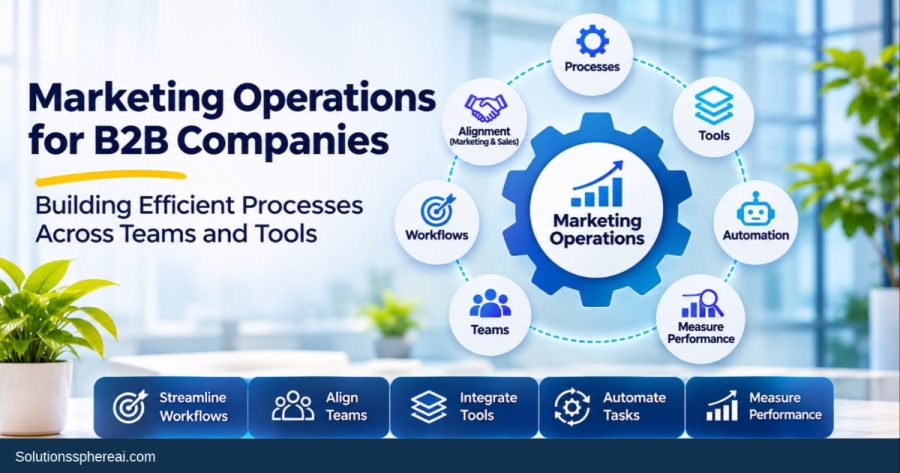
B2B Business Marketing Operations Defined
Marketing operations is the systems, processes, technologies and workflows that enable the execution of marketing activities. This isn’t just about creative campaigns or promotional strategies. It’s about making marketing more organized, measurable and efficient. This is especially important in a B2B environment because marketing activities often involve longer sales cycles, multiple decision-makers and several touchpoints before a prospect turns into a customer.
For example, a prospective client may find a company via an organic search result, visit its website, download a resource, engage with a LinkedIn post and finally send an inquiry. Each interaction generates data that can be leveraged by marketing and sales teams to understand the prospect’s interests. But if these interactions are handled through disconnected systems, important details can be lost. Marketing operations brings these together by establishing consistent ways to gather information, manage leads, measure performance, and communicate across departments.
The Importance of Strong Marketing Processes for B2B Companies
As B2B companies grow, their marketing needs become more complex. Initially, a small team could run campaigns, content creation, lead generation, and reporting without a defined workflow. But as campaigns and customers get bigger, informal processes become increasingly difficult to manage. Workers could spend more time coordinating work than actually doing it.
One common challenge is the lack of clear accountability. When multiple people are involved in a campaign, it’s not always clear who is responsible for approving content, launching ads, monitoring results or sharing performance updates. Without clear responsibilities, tasks can be postponed or duplicated. Another problem is the lack of consistent communication between marketing and sales. Marketing teams can generate leads but may not know which inquiries are valuable to the sales department. Sales representatives might not get enough information about a prospect's prior interactions.
These problems are solved by a well-organized marketing operations framework, which defines responsibilities, standardizes workflows and creates a reliable system to share information. This allows teams to dedicate less time to operational issues and more time to activities that drive business growth.
Creating Better Workflows that Connect Marketing and Sales
One of the most important aspects of B2B marketing operations is marketing and sales alignment. Both departments are revenue generating, but they often have different perspectives on prospects. Sales is about relationship building, need understanding and deal closing; marketing is about attraction and nurturing of prospects.
If these departments operate in silos, the journey from marketing qualified leads to sales qualified leads can be inconsistent. Some prospect may send an inquiry but the sales team is not aware of it, so no response is given immediately. Similarly, marketing could keep sending promotional emails to someone who is already in an active sales discussion.
This will be avoided by developing a shared lead management process. Companies should have clear criteria for qualifying leads, setting out when a lead should be passed on to sales and how quickly to deal with inquiries. A CRM system can facilitate this process by tracking prospect information, logging their interactions, assigning leads to representatives, and monitoring follow-up activities.
Equally important is regular communication between the two departments. Marketing can understand which activities are generating meaningful business opportunities by reviewing lead quality, conversion rates, common customer objections and campaign performance. This feedback, over time, can improve targeting, messaging and campaign planning.
Constructing a Connected MarTech Stack
There are a number of online resources that B2B companies use to manage their marketing activities. These can be customer relationship management systems, email marketing tools, marketing automation tools, analytics programs, content management systems, project management tools and advertising tools. Different tools have different functions, but problems arise when they are used without sufficient coordination.
For example, a marketing team may track website inquiries in one platform, send out email campaigns in another and keep lead information across various spreadsheets. This leads to unnecessary manual work and the potential for inaccurate or outdated information.
A good marketing tech stack should support the whole marketing process from lead generation to campaign performance measurement. Tools should be chosen based on real business needs and not just the latest trends in the industry. Companies should also consider whether their existing platforms can play well together.
CRM systems can help you centralize customer information and marketing automation tools can handle repetitive activities like email sequences, lead notifications and campaign follow-ups. Analytics platforms give you insight into website traffic, user behavior and conversions. Project management tools help teams to coordinate deadlines, approvals, and campaign responsibilities.
But adding more software isn’t necessarily going to make you more efficient. A technology stack that is too complex can cause more problems if employees don't know how to use it. The aim should be to develop a system that is integrated and manageable and which reduces the manual effort and improves the quality of marketing decisions.
Standardizing the Campaign Planning and Execution
There are usually a number of activities going on at the same time during B2B marketing campaigns. Another campaign could require keyword research, landing page creation, content creation, social media promotion, paid advertising, email distribution and tracking leads. The lack of a standard process may complicate coordination of these activities.
A repeatable campaign workflow makes execution more predictable. Every campaign must have a defined objective, whether it’s to generate qualified leads, increase brand awareness, promote a product or drive registrations for an industry event. Once the goal is established, teams can identify the audience, select the appropriate channels, allocate funds, and define how success will be measured.
Approval processes should also be well-defined. Different stakeholders may be required to input for content, advertisements, landing pages and email campaigns. Establishing review timelines and assigning responsibility for final approval helps to prevent unnecessary delays.
Standardization does not mean that all campaigns have to take the same approach. Different strategies for different audiences, different business goals. The idea is instead to build a stable platform so that teams can adapt campaigns without having to rebuild their entire workflow each time.
Cut down on repetitive work with marketing automation
There are many marketing activities that require repetitive tasks and consume valuable hours of work. Typical automated activities might include sending inquiry notifications, updating lead records, sending follow-up emails, assigning tasks and generating routine reports.
Marketing automation allows businesses to create predefined triggers and actions to manage these processes. For instance, a prospect might fill out an inquiry form, and the system could automatically send a confirmation email, log the information into the CRM, notify the relevant sales representative, and schedule a follow-up task.
Automation can assist with lead nurturing, too. Instead of manually reaching out to every prospect, companies can build email sequences based on the prospect’s interests or previous interactions. For example, a user downloading an industry report might be presented with relevant educational content before being introduced to a product or service.
Automation must be underpinned by human judgment. B2B buying decisions are often deeper, involving more in-depth conversations, specific needs, and relationship building. Automation can help speed up response times and ensure consistency, but you still need to have meaningful conversations to understand what your customers are expecting and build trust.
Using Reliable Data to Measure Marketing Performance
Marketing operations is also very important for the improvement of performance measurement. B2B companies generally measure metrics like website traffic, impressions, click-through rates, cost per lead, conversion rates, and customer acquisition costs. While these indicators are useful, looking at individual metrics without understanding how they relate to business outcomes can lead to misleading conclusions.
For example, a campaign may be generating a lot of leads, but very few qualified opportunities. Another campaign may generate fewer inquiries but produce prospects with a higher purchasing intent. If the marketing team only looks at lead volume, it could miss the campaign with more commercial value.
Businesses need to create a consistent reporting framework to connect marketing activities to sales results. This includes tracking lead quality, marketing qualified leads, sales qualified leads, opportunities created, conversion rates, and revenue contribution where accurate attribution can be achieved.
Reporting should also be made accessible to interested stakeholders. When marketing and sales teams have the same performance information, they can identify problems sooner, understand which channels are working, and make better decisions about resource allocation.
Establishing a culture of continuous improvement
Marketing operations is not a one-and-done implementation. Business requirements change, marketing technologies evolve and customer behavior continues to shift. Processes that are effective now may become inefficient as the organization grows.
That’s why companies need to review their workflows regularly and find out where they can improve. That could mean removing unnecessary approval steps, improving the quality of CRM data, simplifying campaign reporting or bringing together platforms that today exist in isolation.
Employee feedback is equally important. The people who run the campaigns and work with the marketing systems on a day-to-day basis are often more familiar than anyone with the operational challenges. Their feedback will help you to identify where tasks take too long, which processes cause confusion and which activities can be automated.
Training must also be viewed as an ongoing responsibility. A new CRM or automation platform is only useful if the employees know how to use it correctly. Clear documentation, internal guidelines and practical training sessions help ensure that new processes are followed consistently across teams.
The Future of Marketing Operations for B2B Companies
As B2B marketing continues to evolve to be more data-driven, marketing operations will remain central to how businesses plan their growth strategies. AI, predictive analytics, automation and integrated customer data platforms are creating new opportunities for improving marketing efficiency. These technologies can help companies recognize trends in customer behavior, personalize communication, prioritize leads and get better visibility into the performance of campaigns.
In the end, marketing operations is about making marketing work better as a function of business. When teams know their responsibilities, systems communicate information well, and performance is tracked and measured consistently, marketing is easier to manage and optimize. For B2B companies aiming to achieve long-term success, investing in campaigns is as crucial as having efficient marketing processes. Businesses can build on this foundation by partnering with SolutionsSphereAi (SSAI) a B2B Digital Marketing Agency Bengaluru to develop more connected, structured, and result-oriented digital marketing strategies. In the end, marketing operations is about making marketing work better as a function of business. When teams know their responsibilities, systems communicate information well, and performance is tracked and measured consistently, marketing is easier to manage and optimize. For B2B companies aiming to achieve long-term success, investing in campaigns is as crucial as having efficient marketing processes. Businesses can build on this foundation by partnering with a B2B Digital Marketing Agency.