

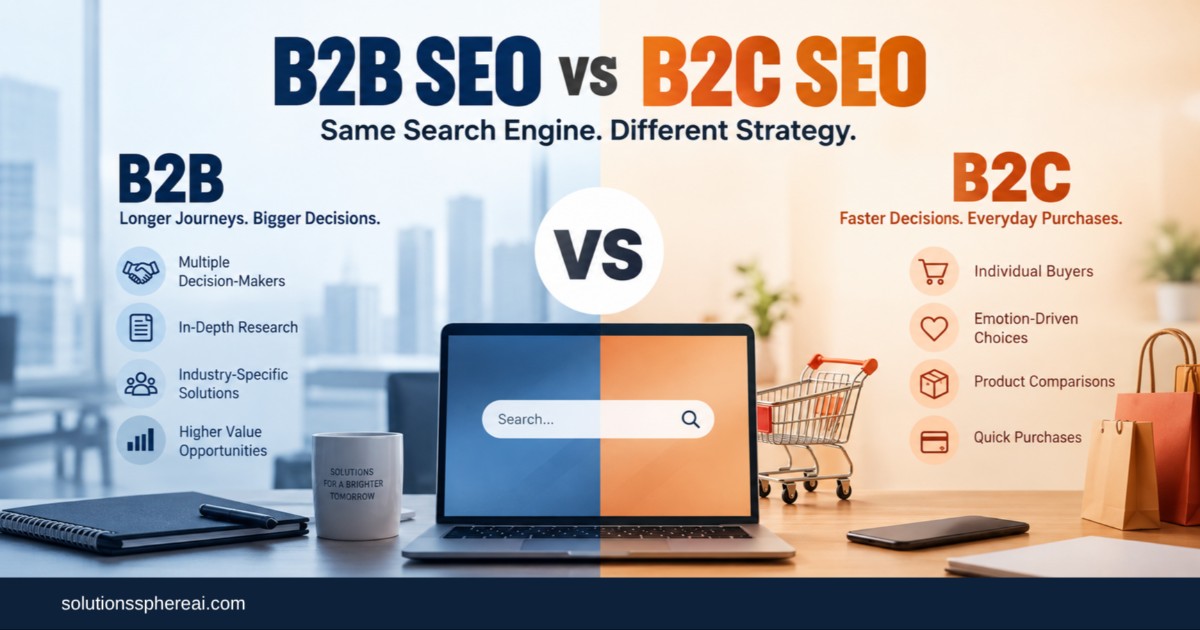
You may think SEO is the same for all businesses, but B2B and B2C SEO are worlds apart. Both are about being found in search engines, but not the same people, not the same searches, not the same decision making. Somebody who is Googling “best running shoes” may check out a few products and buy on the same day. If you’re looking for “B2B CRM software for a manufacturing company,” you might spend weeks researching, feature comparing, talking with a team, and getting approval before you decide. That difference impacts everything from keywords and content to conversions.
Your buying experience is different
B2C purchases tend to be more straightforward. A customer looks for something, compares options, checks reviews or prices, and buys it. In general, B2B buying takes longer. The person doing the search may simply be researching the problem and may not be the ultimate decision maker. A buying decision could include a marketing manager, business owner, technical team, and finance department. So, the B2B SEO needs to support the buyer all the way through the journey, not just to get them onto a product page.
B2B Keywords Are More Intent-Driven
All that is not search volume, especially as it pertains to B2B SEO. A keyword can bring in a lot of visitors, but very few potential customers. A more specific keyword that has a few hundred searches will pull in people who are actually looking for a solution. For example, “digital marketing” is a broad term, while “B2B performance marketing agency” is more specific. The second keyword may have less traffic but the people searching for it may have much stronger commercial intent. That’s why B2B SEO often cares more about relevance and intent than the biggest numbers.
B2B Content Tends to be More In-Depth
Sometimes B2C content is simple and fast to consume. Product reviews, comparisons, buying guides and short articles are there to help someone to make a decision. B2B buyers often need to see more before they trust a company. They might want to know how a solution works, if it is suitable for their industry, what implementation entails, what results they can anticipate and how it stacks up against alternatives. This is why B2B brands do well with things like in-depth guides, case studies, comparison pages, industry articles, FAQs, and research-based content. It’s not about making the content longer than necessary. It is to give the reader enough useful information to make the next decision.
B2B SEO needs stronger topical authority
B2B companies are often in specialized industries so a few random blog posts won’t cut it. For instance, an industrial software company could develop content related to automation, predictive maintenance, integrations, implementation, use cases, ROI, and industry challenges. By connecting these topics with internal links and around a core subject, they help establish the website as a useful resource in that area. This is also where working with a B2B SEO Agency can help businesses build a structured content strategy around their industry, audience, and search intent. And this is where pillar content and topic clusters can come in handy.
Conversions Don’t Always Happen Right Away
One of the biggest differences between B2B and B2C SEO is how you define a conversion. The B2C journey could look like Search → Product → Cart → Buy. For B2B it could be Search → Blog → Guide → Case Study → Service Page → Inquiry → Sales Call. A visitor downloading a report, asking for pricing, signing up for a webinar, or filling out a contact form are all valuable actions. So B2B SEO shouldn’t be measured by the traffic it drives alone. What matters much more is the quality of that traffic and whether it results in meaningful business opportunities.
Relevance is Important, But Backlinks are More Important
Backlinks are important for both B2B and B2C sites, but B2B brands should put a heavy emphasis on industry relevance. A link from a quality industry publication, professional association or a specialist website can be worth more than a number of unrelated links. B2B brands can establish authority through expert articles, original research, industry reports, partnerships, case studies, and thought leadership.
AI Search Is a Game-Changer
AI-powered search experiences are also transforming search. You can’t just stuff keywords in there anymore. Businesses need useful, well-organized content that clearly shows expertise and answers real questions. This is a chance for B2B companies to establish strong topical authority and to become a trustworthy source of information within their industry.
What’s the takeaway
While B2B and B2C SEO are based on the same fundamentals, there’s a different strategy behind them. B2C SEO is generally about reaching a lot of people, and helping them to make fairly quick buying decisions. B2B SEO is more about niche audiences, longer buying cycles, specialized search intent, trust and multiple decision makers. It's not simply about getting more visitors. It’s about getting the right visitors, answering their questions, establishing confidence and moving them toward becoming customers.
How SolutionsSphereAI May Help
At SolutionsSphereAI (SSAI), SEO is much more than a way to improve rankings and traffic. It’s about building a strategy around your audience, search intent, content and business goals. From technical SEO and keyword research to topic clusters and content strategy, SSAI helps B2B companies build organic visibility that can fuel long-term growth. For businesses looking for SEO Services Bengaluru, having a strategy that combines technical optimisation, useful content, keyword research, and long-term authority building can help create a stronger organic presence.