

Why You Should Allocate Your Digital Marketing Budget Strategically
Digital marketing budget allocation is the distribution of marketing resources across different channels and activities according to business priorities, audience behavior and expected returns. This means a more thorough understanding of the customer journey for B2B companies than simply investing in the channels that drive the most clicks. A prospective customer may discover a company through a Google search, read the company’s blog, engage with its LinkedIn content, download a whitepaper, attend a webinar and eventually request a sales consultation. Each of the various touchpoints plays a different role in the purchase decision. If a business spends its entire budget on paid advertising and doesn't invest in content, search engine optimization or lead nurturing, it may find some initial interest but struggle to convert prospects into customers. Similarly, depending only on organic marketing may restrict immediate visibility in a crowded marketplace. Strategic allocation allows for the integration of marketing channels to attract, educate, engage and convert potential buyers.
Identify Business Goals Before Selecting Marketing Channels
To allocate the budget correctly, you need to know what the business is trying to achieve. If you’re a company entering a new market, your priorities might be brand awareness and audience reach. If you’re an established B2B organization, your priorities might be generating qualified leads, improving conversion rates or expanding existing customer relationships. These goals call for different spending strategies. For example, a technology company launching a new enterprise software solution might use search advertising, educational content, LinkedIn campaigns and webinars to reach decision-makers and show its expertise. Alternatively, a consulting firm looking to drive more inquiries from a particular industry may place more emphasis on targeted search campaigns, industry-specific landing pages and thought leadership. Before giving out money businesses should have measurable key performance indicators (KPIs) in place like marketing-qualified leads, sales-qualified leads, cost per lead, customer acquisition cost, conversion rate and marketing-attributed revenue. Marketing spend becomes a strategic investment – rather than a collection of disparate activities – when objectives and criteria for measurement are defined upfront.
Invest in SEO and Content Marketing for Long-Term Gains
Search engine optimization and content marketing should play a key role in a B2B digital marketing strategy, as business buyers often research solutions before contacting a vendor. They compare service providers, check industry challenges, assess expertise and look for proof that a company understands their needs. A strong organic search presence enables businesses to be found by potential customers during this research phase without having to pay for every single website visit. Budgeting should cater for keyword research, technical SEO, content development, website optimization and the creation of valuable resources such as industry guides, case studies, comparison articles and expert insights. For example, a company providing enterprise automation solutions could produce content about workflow inefficiencies, challenges with implementation, integration needs and measurable improvements in productivity. This type of content brings in the right audience and helps prospects understand the value of the solution. SEO usually takes a long time to bring meaningful results, but its long term value can be much greater than the initial investment. So businesses should judge organic marketing on long-term results in relevant traffic, qualified inquiries, search visibility and conversions – not on instant gratification.
Pay for Advertising With Clear Conversion Objectives
Paid advertising can help B2B businesses target audiences, create demand and accelerate lead acquisition. But paid campaigns can eat up a big portion of the marketing budget quickly if they aren’t built around meaningful business outcomes. Google Ads can target high-intent prospects who are actively searching for a product or service, while LinkedIn advertising can target professionals based on things like job title, industry, company size and seniority. The correct channel depends on the audience, the complexity of the offering and the buying intent you are targeting. Start with controlled campaigns, testing different audience segments and messages, and driving traffic to landing pages that are designed for conversion. They should also be tracking the quality of leads generated, not just the number of form submissions. However, a campaign with a lot of cheap leads that never convert to sales may be worth less than a campaign that generates fewer but highly qualified prospects. Businesses can cut wasted spend and improve the efficiency of campaigns through regular performance reviews, tracking conversion, managing negative keywords and systematic testing.
Incorporate LinkedIn and Social Media into the B2B Strategy
LinkedIn is huge in the B2B marketing world. It allows you to connect with people in your industry, decision-makers, potential partners and buyers. However, effective LinkedIn marketing is more than just publishing promotional updates or running advertisements. Businesses should invest time and resources in thought leadership, employee advocacy, industry conversations, relevant organic content, targeted campaigns and relationship building. Consistent publishing builds credibility and insights from company leaders and subject-matter experts demonstrate practical knowledge of customer challenges. Other social media platforms may also be effective if they align with the audience and communication goals. The trick is to select platforms on the basis of business relevance, not just popularity. B2B organizations should measure engagement alongside metrics like relevant website visits, growth of audiences among target accounts, content-assisted conversions and inquiries. Integrating social media with website content, email marketing, and sales outreach, businesses can deliver the same brand experience throughout the customer journey.
Set Your Email Marketing and Lead Nurturing Budget
B2B purchase decisions are seldom made after one interaction. It might take weeks or months for prospects to compare vendors, get internal buy-in, analyze budgets and build confidence in a solution. So businesses should invest in lead nurturing instead of just focusing on acquiring new leads. Email marketing can help here with newsletters containing educational content, industry updates, case studies, product information and timely follow-up messages. Marketing automation enables businesses to segment audiences, personalize communication and deliver relevant information based on a prospect’s interests or position in the buying journey. For instance, a person downloading a guide on a business challenge may benefit from a series of educational emails before being invited to book a consultation. Good nurturing keeps the brand in front of the consumer without banging them over the head with sales messages. In budgeting, you need to think about email platforms, content creation, automation workflows, database quality, and campaign analysis. Businesses should also ensure that their communications comply with applicable privacy requirements, and respect recipients’ consent and preferences.
Measuring Marketing Performance with Data and Analytics
An effective marketing budget will be flexible as performance data tells you what's working and what needs improvement. To build a solid measurement framework that connects marketing activity with sales results, businesses need to Key metrics include cost per qualified lead, lead to opportunity conversion rate, customer acquisition cost, pipeline contribution, return on marketing investment, and customer lifetime value. Each metric offers a different view. For example, high website traffic may be a sign of strong visibility, but low conversion rates can expose a disconnect between search intent, messaging, and landing-page experience. Likewise, a campaign that requires a high upfront cost can still be profitable if it continually attracts enterprise customers with a large lifetime value. Businesses also need to know that attribution can get messy because of long sales cycles and multiple touchpoints. Instead of evaluating each channel separately, marketers need to think about how channels combine to build pipeline and revenue. Within organizations, regular reporting, controlled experiments and periodic budget reviews can help move resources to activities that show meaningful business impact.
Create a Budget That's Balanced and Keep Improving It
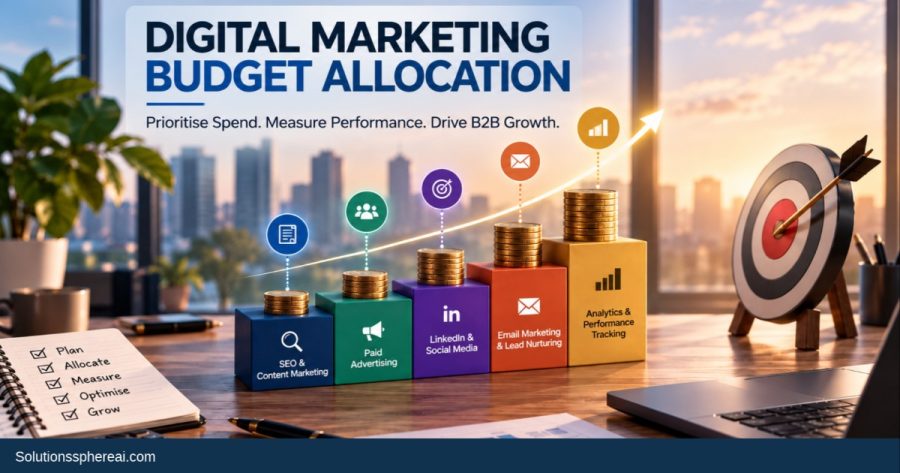
There is no magic percentage that every B2B business should be spending on SEO, paid advertising, social media, email marketing or anything else. The right mix depends on the company’s stage of growth, the resources available, the competitive landscape, the sales cycle, and the current marketing performance. A business with low brand awareness may need to spend more on visibility and demand generation, whereas a company with a robust inbound pipeline could benefit from improving lead nurturing and conversion rates. One practical tip is to create a baseline budget for proven activities, set aside a chunk for experimentation and ensure you have flexibility to respond to changing results. For example, a business might start out investing in SEO and content, paid search, LinkedIn, email marketing and analytics, then evaluate lead quality and contribution to the sales pipeline and revisit the mix. The goal isn't to get the allocation perfect immediately, but to build a repeatable process for planning, testing, measuring and iterating. Businesses also have to consider less visible but essential expenses such as marketing technology, creative production, landing page development and campaign management to avoid underestimating the true cost of execution. A digital marketing agency helps businesses strengthen their online presence, reach the right audience, generate qualified leads, and drive measurable growth through strategic digital campaigns.
Convert Marketing Spend Into Real Business Growth
So, at the end of the day, digital marketing budget allocation is about making informed decisions that connect marketing investment to business outcomes. For B2B organizations, sustainable expansion requires a coordinated approach that combines long-term visibility via SEO and content, targeted demand generation via paid campaigns, professional engagement via LinkedIn, and consistent lead nurturing via email marketing. Continuous optimization enables businesses to respond to changing market conditions and customer needs, and data-driven measurement keeps these activities accountable. Winning strategy is not always the one with the biggest budget, but the one that uses the available resources to the right audience, the right channels and the right objectives. Businesses that view marketing as a measurable growth function, and not as an isolated expense, can build better customer relationships, improve lead quality, and create a more predictable path to revenue. SolutionsSphereAI (SSAI) takes a structured approach to planning and execution, helping businesses strategically approach digital growth by connecting marketing priorities to the opportunities that matter most. If you are an organization looking for a strategic digital partner, check out B2B Digital Marketing Agency Bengaluru to learn more about how SSAI may support you with a more focused, measurable and growth-oriented digital marketing strategy.