

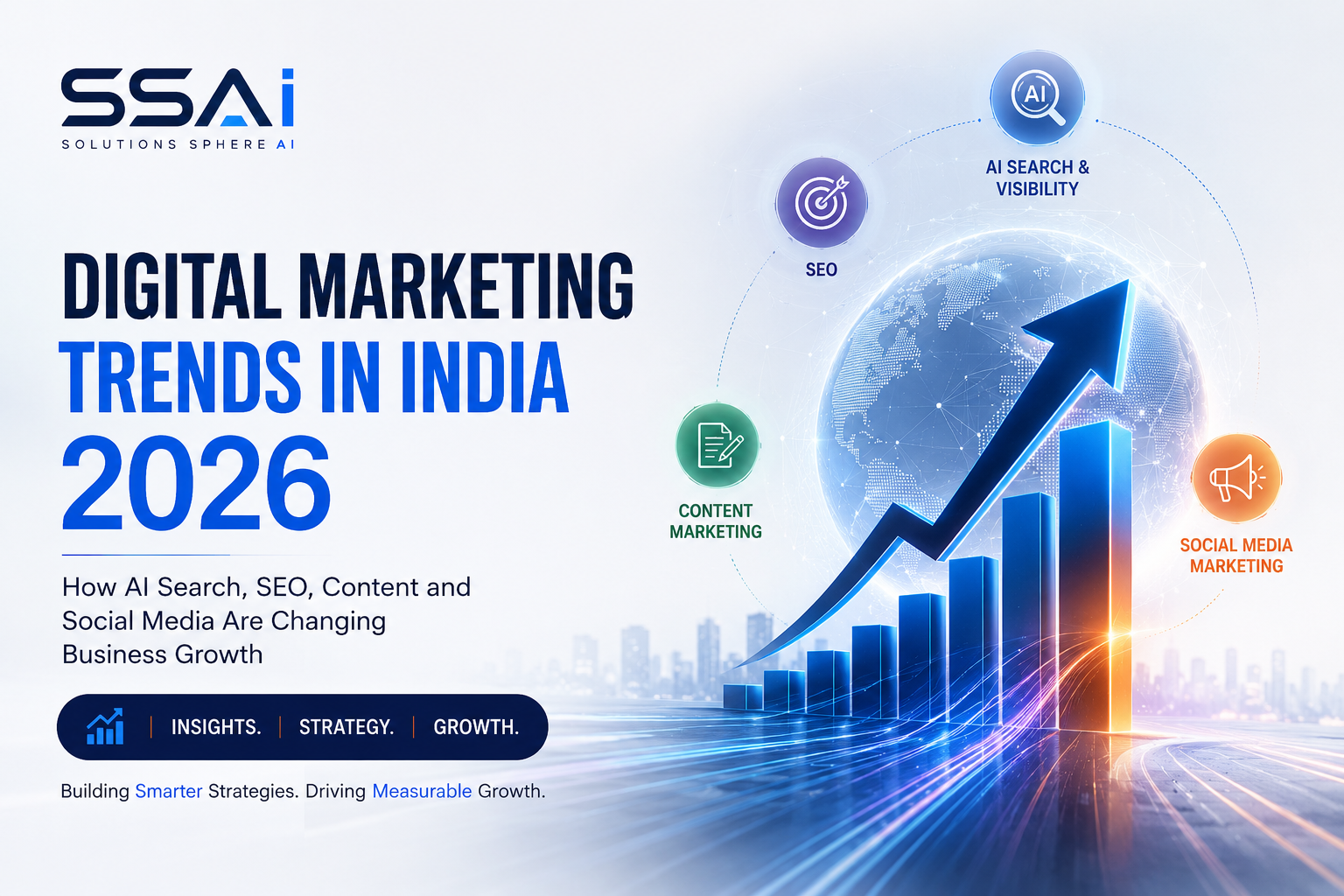
Digital marketing in India is entering a new phase. The way customers discover businesses, research products and services, compare options, and make purchasing decisions is changing rapidly. While search engines, social media, paid advertising, and websites continue to play an important role, the rise of artificial intelligence is creating new ways for people to discover information and interact with brands.
For businesses in India, this means that digital marketing can no longer be treated as a collection of separate activities. SEO, content marketing, social media, and emerging AI-powered search experiences need to work together as part of a broader digital growth strategy. In 2026, businesses that focus on visibility, useful content, strong digital experiences, and measurable outcomes will be better positioned to compete online.
AI Is Changing the Way People Search
One of the most significant digital marketing trends in 2026 is the growing influence of artificial intelligence on search and information discovery. Instead of always entering short keywords into a traditional search engine and visiting several websites, users can increasingly ask detailed questions through conversational AI platforms and receive summarized answers.
This shift is changing the way businesses need to think about online visibility. Ranking on a traditional search engine remains important, but businesses also need to consider how their brand, expertise, products, services, and content can be discovered through AI-powered search experiences.
This emerging area is often referred to as AI search optimization or AI search visibility. Businesses can prepare by creating clear and authoritative website content, demonstrating expertise within their subject areas, maintaining consistent business information, and publishing useful resources that directly answer customer questions.
AI search does not make SEO irrelevant. In many ways, it makes a strong SEO and content foundation even more important because AI systems need reliable information to understand businesses, topics, products, and services.
SEO Is Evolving Beyond Traditional Keyword Rankings
Search engine optimization remains one of the most important digital marketing strategies for businesses in India. However, modern SEO is no longer simply about adding keywords to web pages and trying to achieve higher rankings.
Search engines have become increasingly sophisticated at understanding search intent and evaluating the usefulness and relevance of content. Businesses therefore need to understand what potential customers are actually looking for and create pages that satisfy those needs.
For example, someone searching for "SEO" may simply want to understand what search engine optimization means, while someone searching for "SEO company in Bangalore for manufacturing businesses" is likely looking for a service provider. These searches represent different stages of the customer journey and require different types of content.
Modern SEO also requires businesses to develop topical authority. Rather than publishing unrelated articles, companies can build comprehensive resources around topics that are relevant to their customers. A digital marketing company, for example, can develop content around SEO, AI search, content marketing, social media marketing, lead generation, and digital marketing strategy.
Technical SEO continues to be an important part of this process. Website speed, mobile usability, crawlability, indexation, internal linking, structured data, URL structure, and overall website performance all contribute to creating a strong foundation for organic search visibility.
Content Marketing Is Becoming a Competitive Advantage
Content marketing has evolved far beyond simply publishing regular blog posts. In 2026, businesses need content that demonstrates expertise, answers real customer questions, and provides genuine value throughout the buying journey.
Useful content can take many forms, including educational articles, industry guides, case studies, research, FAQs, videos, LinkedIn content, comparison guides, and detailed service resources. The objective should not simply be to produce a large volume of content but to become a useful and trustworthy source of information for the people a business wants to reach.
This is particularly important as AI-generated content becomes more accessible. Producing large numbers of generic articles is no longer a meaningful competitive advantage. Businesses should focus on original insights, practical examples, industry knowledge, expert perspectives, and information that genuinely helps the reader.
A strong content marketing strategy should therefore connect business expertise with customer questions and search intent. When done correctly, content can support SEO, improve brand authority, generate organic traffic, and help potential customers make informed decisions.
Social Media Is Becoming a Discovery Channel
Social media is no longer simply a place for businesses to publish promotional updates. It has become an important channel for brand discovery, education, engagement, and customer research.
Depending on the target audience, platforms such as LinkedIn, Instagram, YouTube, and other social networks can influence how customers discover businesses and evaluate their credibility. For B2B companies, LinkedIn can play an important role in demonstrating expertise and building professional relationships, while visual platforms can be particularly effective for consumer-focused businesses.
Effective social media marketing should focus on more than follower counts. Businesses should use social platforms to educate their audience, communicate their expertise, create conversations, strengthen brand recognition, and build a community around their products or services.
Social media should also complement other digital marketing activities. A useful blog article can become a LinkedIn post, a short video, an infographic, or a series of social posts. This creates more value from a single piece of strategic content while maintaining consistency across different channels.
Businesses Need an Integrated Digital Marketing Strategy
One of the biggest challenges businesses face is treating every digital channel as a separate activity. SEO may be handled by one team, social media by another, content by someone else, and paid advertising independently. When these activities are not connected, businesses can end up spending resources across multiple channels without having a unified growth strategy.
An integrated digital marketing strategy connects these activities around common business objectives. For example, a business could create a detailed article around an important customer problem, optimize it for search engines, distribute it through social media, create short-form content from the article, promote the strongest content through paid advertising, and direct visitors to a conversion-focused landing page.
This approach allows SEO, content marketing, social media, and performance marketing to support one another instead of operating as isolated activities. The result is a more connected digital growth system that can support both visibility and lead generation.
Local SEO Remains Important for Indian Businesses
For businesses that serve specific cities, regions, or local markets, local SEO continues to be an important part of digital marketing. Customers frequently search for businesses, products, and services using location-specific queries, making local visibility particularly valuable for companies targeting regional customers.
Businesses should maintain accurate information across their digital profiles, optimize their websites for relevant local search intent, manage their Google Business Profile effectively, collect genuine customer reviews, and create useful location-specific content where appropriate.
For companies expanding across multiple cities in India, local SEO can become an important part of a broader search strategy. However, location pages should provide genuine value rather than simply repeating the same content with different city names.
Better Measurement Is Becoming More Important
As digital marketing becomes more sophisticated, businesses also need to become more disciplined about measuring performance. Website traffic, impressions, followers, and engagement can provide useful information, but these metrics do not always translate directly into business growth.
Businesses should increasingly focus on metrics such as qualified leads, conversion rates, cost per lead, customer acquisition cost, organic conversions, return on advertising spend, and revenue generated from marketing activities.
The right metrics depend on the business model and marketing objectives. The important principle is that marketing performance should ultimately be connected to meaningful business outcomes rather than vanity metrics alone.
AI Will Become Part of the Marketing Workflow
Artificial intelligence is not simply another marketing channel. It is increasingly becoming part of how marketing teams research, plan, create, analyze, and optimize campaigns.
Businesses can use AI to support activities such as content research, topic discovery, audience analysis, campaign analysis, reporting, customer communication, and marketing automation. These capabilities can help marketing teams work more efficiently and make better use of their time.
However, AI should not replace human expertise and strategic thinking. Content still needs to be accurate, relevant, original, and aligned with the brand. Human judgment remains essential for understanding customers, validating information, developing strategy, and ensuring that marketing communications are genuinely useful.
The strongest approach is therefore to use AI as a productivity and intelligence layer while keeping people responsible for strategy, quality, and decision-making.
Search Visibility Is Becoming Broader Than Google
Traditional SEO has primarily focused on search engine visibility, particularly Google. However, the modern customer journey can involve many different digital platforms.
Depending on the industry, customers may discover businesses through search engines, AI assistants, YouTube, LinkedIn, Instagram, Google Maps, marketplaces, industry directories, review platforms, and other online communities.
This means businesses need to think about digital discoverability more broadly. A company's website remains its most important owned digital asset, but its online presence should extend across the platforms where its target customers actually search for information.
Building a consistent presence across relevant channels can strengthen brand recognition and increase the number of opportunities for potential customers to discover a business.
Websites Need to Convert Traffic Into Business
Generating website traffic is only one part of a successful digital marketing strategy. A business may attract thousands of visitors through SEO or advertising, but if the website does not communicate its value clearly or make it easy for visitors to take action, that traffic may not produce meaningful results.
A modern business website should help visitors quickly understand what the company offers, who it serves, why it is credible, and what they should do next. Clear messaging, intuitive navigation, useful content, strong calls to action, mobile usability, and conversion-focused landing pages all contribute to this experience.
This is where SEO, content, user experience, and conversion strategy need to work together. The objective should not simply be to bring more people to a website but to turn relevant visitors into meaningful business opportunities.
What Should Indian Businesses Prioritize in 2026?
Indian businesses do not need to adopt every new digital marketing trend at once. A better approach is to establish a strong foundation and then expand based on business objectives and customer behaviour.
The first priority should be creating a technically sound, mobile-friendly, and conversion-focused website. Businesses should then develop an SEO strategy based on customer search intent and create useful content that demonstrates genuine expertise.
Social media should be used strategically on platforms where the target audience is active, while AI should be incorporated into marketing workflows where it can improve efficiency and decision-making. At the same time, businesses should track qualified leads, conversions, and other meaningful business outcomes instead of focusing only on traffic and engagement.
Most importantly, these activities should work together. SEO can drive discovery, content can build authority, social media can strengthen engagement, and AI can improve both efficiency and search visibility.
The Future of Digital Marketing in India
Digital marketing in India is becoming more sophisticated. The next stage is not simply about ranking for keywords, publishing more social media posts, or increasing advertising budgets. It is about being visible, useful, credible, and accessible wherever potential customers search for information.
Businesses that combine AI & Search Visibility, SEO, Content Marketing, and Social Media Marketing can build a stronger and more sustainable digital presence.
The businesses that succeed will not necessarily be the ones that publish the most content or spend the most money. They will be the ones that understand their customers, create useful digital experiences, build trust, and consistently measure whether their marketing activities are contributing to business growth.
How SSAI Can Help
Solutions Sphere AI Pvt Ltd (SSAI) helps businesses strengthen their digital presence through a focused approach to modern digital marketing. Our services span AI & Search Visibility, SEO, Content Marketing, and Social Media Marketing, helping businesses improve online discoverability, build brand authority, engage their target audiences, and create sustainable opportunities for growth.
Our approach combines strategic planning, relevant content, search optimization, social media, and emerging digital technologies to help businesses adapt to an evolving online environment.
Ready to strengthen your digital presence?
Explore our Digital Marketing Services or Contact SSAI to discuss your business goals.