

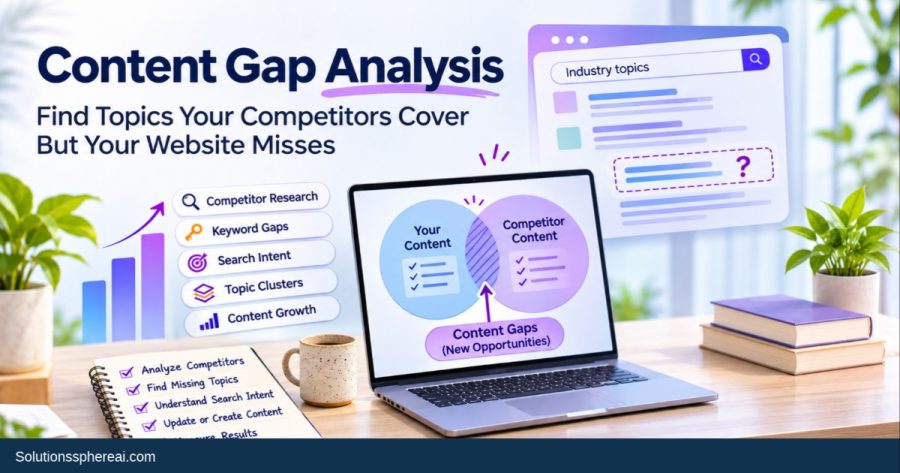
Instead of always trying to think of new blog ideas, businesses can use competitor research to find out what their audience wants to know and where their own content is lacking. It takes the focus off creating more content and puts it on creating content with a clear purpose. When done right, content gap analysis helps businesses identify new keyword opportunities, build topical authority, and attract visitors who are genuinely interested in the products or services they offer.
What is a Content Gap Analysis and Why Should You Care?
Content gap analysis is a comparison of your website's content against that of your competitors to find topics, keywords, and search queries that you haven't covered adequately. These may be entire topics you haven’t yet addressed, keywords your competitors rank for that you don’t, questions your posts don’t answer, or key stages of the customer journey that are largely overlooked.
But content gaps are more than just missing keywords. There might be an article already on your website about a certain topic but some other competitor might be doing a better job of it with more in depth content and real world examples or even answering questions that your article fails to answer. In those cases the chance is not necessarily to build another blog, but to improve the one you have.
This is an important distinction for businesses that invest in SEO. A good content strategy should help potential customers find valuable information at different stages of the buying journey. Content gap analysis helps pinpoint where that journey is incomplete and provides marketers with a clearer path for future content.
1. Know Who Your True Search Competitors Are
But before you begin content analysis, you need to find out what competitors are worth analyzing. Interestingly, your business competitors may not always be your SEO competitors.
A company may be competing with another business for customers, but not necessarily competing with that business in search results. So a B2B technology company may find that industry publications, consulting firms and specialized blogs are all ranking for the same informational keywords the company is targeting.
Start by searching for websites that appear in search results for keywords relevant to your industry and services. Check out their blogs, resource pages, service pages and educational content. Look at the subjects they return to again and again, the questions they appear to answer.
Don’t just look at big companies with websites that have been around for a long time. Smaller niche sites can sometimes provide valuable opportunities because they tend to address the problems of a specific audience that larger competitors may ignore.
The goal is simple: Find out what sites are attracting the audience you’re trying to reach, and what kind of information is helping them do it.
2. Use Keyword Research Tools to Discover Untapped Opportunities
It takes time to manually compare multiple websites. That’s where tools like SEMrush and Ahrefs can come in handy.
You can use their keyword gap analysis to compare your site to competing domains and identify search terms for which competing websites rank, but yours doesn’t.
Imagine your website already publishing articles on the basics of SEO, keyword research and link building. When doing competitor research you see competing websites ranking for topics such as technical SEO audits, marketing attribution, conversion rate optimization, and search intent analysis.
These can be opportunities to expand your content strategy as long as they are relevant to your audience and services.
But don't just choose keywords based on search volume. A broad keyword might bring in thousands of visitors, but a more focused search phrase is likely to bring visitors who are closer to a business decision.
Someone searching for general knowledge of digital marketing may just be studying the subject. Someone looking for B2B marketing automation tips may already be looking for a solution to a specific business problem.
Don’t look at traffic as the only measure of success – look at the importance and potential value of a keyword.
3. Know Your Search Intent Before Making New Content
Finding a keyword gap is half the battle. Then the next step is to understand what people are looking for that term for.
Search intent is what users want to find when they type a query into a search engine. Generally, there are four types of search intent: informational, navigational, commercial and transactional.
Think: someone searching for technical SEO. They probably want to know why, get some hands on help or find answers to technical website issues. But someone searching for the best SEO agency in Bengaluru might be comparing service providers before making the decision.
If your competitors have detailed comparison guides and your website consists only of generic informational articles, you are probably missing the opportunity to reach users with higher purchase intent.
A simple way to understand search intent is to look at the pages that rank on the first page of search results. Look at their structure, how detailed they are, their format and the questions they answer. This gives you an idea of what the searchers are looking for and helps you create content that addresses the real need behind the keyword.
4. Find the Gaps in Your Current Content
Not every content gap will need a brand new article. Sometimes the information is on your website, it just needs to be better.
But you might find an older blog that explains a marketing concept, but not how to put it into practice. Another article might be about a relevant keyword, but not have useful examples, up-to-date information, or answers to common questions.
Look at what you got and then see where you can add more value. Make sure the information is still accurate, that no important subtopics are lost, and that related information can be easily found through internal links.
And watch out for keyword cannibalization as well. This happens when multiple pages on your site are targeting the same or similar search queries without a clear purpose. Rather than creating another article on the same topic, consider updating, merging or reorganizing the existing pages.
Sometimes it is better to improve an article that is already imprinted, than to publish a new one.
5. Target Content Gaps with Business Value
When you discover potential voids, it's tempting to write about everything your competitors are writing about. But that can quickly lead to a content strategy that has no focus.
Not every keyword is worth chasing, not every hot topic is relevant to your business.
Prioritize opportunities based on how well they align with your services, audience interest, search intent, ranking difficulty, and ability to generate qualified leads.
A B2B digital marketing company, for example, should be writing about things like SEO, lead generation, performance marketing, marketing automation and conversion optimization—not about unrelated topics that just happen to have high search volumes.
It also helps to build these opportunities out in a content calendar. Find topics that need to be addressed quickly, articles that need updating, and topics that can be turned into longer-term content clusters.
This results in more organized content creation processes and ensures each new piece of content is contributing to a larger marketing goal.
6. Content Gaps: A Topic Cluster Strategy to Fill Them In
One of the biggest mistakes companies make is treating each blog as its own piece of content. Having dozens of articles on your website is great, but if you don’t have a clear structure to connect them, it’s unlikely you’ll be able to cover important topics in-depth.
This is where a topic cluster strategy can help.
Pick a bigger pillar topic, then write supporting articles that discuss specific parts of that topic. Add relevant internal links so that users can easily navigate between the related topics.
For example, an article on lead qualification, landing page optimization, LinkedIn prospecting, marketing automation, and lead nurturing can support a pillar page on B2B lead generation.
If competitor research reveals that your website is missing important subtopics in this cluster, these are opportunities to shore up your overall content structure.
This enables you to create a more comprehensive resource for your audience over time, rather than simply giving them one-off articles that only partially answer their questions.
7. Measure Results and Keep Improving Your Content
A content gap analysis is not finished once an article has been published. You also need to know if the content is producing the expected results.
Google Search Console can help you track impressions, clicks, average search positions, and the queries that bring visitors to your website. Google Analytics can provide deeper insights into traffic sources, user engagement, and conversions.
Concentrate on articles that get a lot of views but not a lot of click-throughs. They need better title tags and meta descriptions or better match to search intent. Pages that get organic traffic but aren’t engaging might also need better information or links to relevant services.
Don’t expect every new article to rank right away. Organic visibility isn’t instantaneous. Instead of evaluating content performance after a few weeks, it should be monitored on a regular basis.
Competitors will create new content, search behavior will change and your audience’s expectations will change. Regular analysis will keep your website from falling behind.
The Bottom Line
Want a successful content strategy? It’s not about putting out more articles than your competitors. It’s about understanding what your audience needs to know, identifying the gaps on your website, and providing them with information that is truly helpful.
A content gap analysis can be a practical way for businesses to escape the haphazard blog publishing trap. By studying competitors, analyzing keywords, understanding search intent, optimizing content and using topic clusters marketers can build a website that covers their industry more effectively, attracting more customers.
The real value of competitor insights is that they are a starting point, not a blueprint. Don't just repeat what the rest of the sites are saying. Try to explain better, give more useful examples, and provide information that actually helps your audience with their real problems.
At SSAI, we believe that a strong content strategy is the foundation for meaningful organic growth. As a B2B Digital Marketing Agency, we focus on driving SEO through research-driven content marketing strategies that help businesses strengthen their online presence. As a B2B Digital Marketing Agency Bengaluru, SSAI helps businesses improve search visibility, build topical authority and attract audiences through strategic digital marketing.
A content strategy agency can make this kind of competitive gap analysis part of an ongoing process rather than a one-time exercise, so new opportunities keep surfacing as competitors publish.