

Start With a Clear Purpose
Before you start writing the page, decide exactly what you want it to achieve. This is one of the simplest things to get right, yet it is often overlooked. Many B2B landing pages try to do everything at once. They promote several services, ask visitors to download something, encourage them to call, push a newsletter signup and include links to half a dozen other pages. The result is a page that gives visitors plenty of options but very little direction.
A landing page should have a clear primary goal. If you're offering a free consultation, the page should make that consultation the focus. When promoting a software demo, everything should naturally lead to the ask for the demo. If you’re offering a report or guide, the value of that asset should be clear and the download process simple. When a visitor knows what the page is offering and what they can do next, there is far less friction.
Make It Clear What You Actually Offer
One of the biggest mistakes businesses make with landing-page copy is trying too hard to sound impressive. Phrases such as “driving digital transformation through innovative solutions” might sound professional, but they don't tell a potential customer much. Your visitor shouldn't have to spend time figuring out what you do.
The headline should communicate the value of your offer as quickly as possible. Think about what your customer is trying to achieve and put that at the centre of the message. If you help B2B companies generate qualified leads, say so. If your service helps businesses improve their organic visibility, make that clear. If you're offering software that solves a particular operational problem, explain the problem and the outcome.
The supporting copy can then provide a little more context. It doesn't need to explain your entire business. Its job is simply to help the visitor understand why the offer is relevant to them and why they should keep reading.
Explain the Outcome, Not Just the Service
B2B companies often describe what they provide without explaining why it matters. An agency might list SEO, content marketing, paid advertising and social media management, for example, but the customer isn't necessarily looking to buy a list of services. They're looking for a business result.
They want more qualified leads. They want better visibility. They want a lower cost per acquisition. They want their sales team to have more opportunities to work with. They want their website to contribute more directly to revenue.
This is why your landing page should connect your service to the outcome it can help create. Instead of simply saying what you do, explain how it helps solve the customer's problem. This makes the page more useful and gives potential customers a much better reason to continue.
At the same time, avoid promising results that you cannot guarantee. B2B buyers are generally experienced enough to recognise exaggerated claims. Honest, specific and realistic messaging often creates more confidence than promises of instant growth.
Keep the Journey Consistent
Imagine searching for “B2B lead generation services,” clicking on an advertisement that promises exactly that, and then arriving on a homepage that talks about web design, social media, branding, SEO, AI and ten other services. It creates a disconnect.
The visitor came with a particular need, so the landing page should continue that conversation. The message in the ad, search result, email or social post should match what they find on the page. If someone clicked because they were interested in B2B lead generation, they should immediately see content related to B2B lead generation.
This is especially important when you’re running paid campaigns. Every click has a price, and simply driving traffic to a generic page and hoping they find their way around isn’t always the most efficient use of your budget. A focused landing page gives them a much clearer path.
Give Visitors a Reason to Trust You
Even if someone wants your service, they may not be ready to call you right away. They might be wondering whether you've worked with businesses like theirs, whether you understand their industry or whether your service will actually deliver what you're promising.
This is where trust becomes important.
Real examples, customer experiences, case studies, client logos and relevant results can help answer those questions. Instead of just telling visitors you are experienced, show them what experience looks like. A short case study explaining the challenge a client faced, what was done and what changed as a result can be far more convincing than a paragraph describing how great your company is.
Testimonials can also help, particularly when they feel specific and genuine. A statement that explains how a service helped solve a real business problem feels much more credible than a generic five-star review.
Trust shouldn't be treated as something you add at the very bottom of the page. It should appear naturally throughout the visitor's journey, especially around the point where you're asking them to get in touch.
Don't Ask for More Information Than You Need
There's another reason B2B landing pages lose potential leads: the form feels like too much work.
A visitor may be willing to request a consultation, but that doesn't necessarily mean they're willing to fill out fifteen fields before doing so. Asking for information that you don't genuinely need can create unnecessary friction.
The right form depends on your business. If your sales team needs certain information to understand whether a prospect is a good fit, some additional questions may make sense. But every field should have a reason for being there.
The same thinking applies to the call-to-action. “Submit” is functional, but it doesn't communicate much. “Request a Consultation,” “Book a Strategy Call” or “Get a Demo” gives the visitor a clearer idea of what happens when they click.
The easier you make the next step, the more likely people are to take it.
Make the Page Easy to Read
A landing page can contain excellent information and still perform poorly if it is difficult to read. People don't usually sit down and read every word on a webpage. They scan. They look at the headline, jump between sections, notice bold statements, look for proof and search for the call-to-action.
Your page should work with that behaviour rather than against it.
Clear headings, short paragraphs, comfortable spacing and a logical flow make a page easier to understand. The design should support the content rather than compete with it. Every element should have a purpose.
It's also important to remember that many visitors will view the page on their phones. A form that works perfectly on a desktop might be frustrating on a smaller screen. Text that looks comfortable on a large monitor may become difficult to read on mobile. Buttons need to be easy to tap, images shouldn't slow the page down and the most important information shouldn't be buried.
Answer the Questions Before They Become Objections
A potential customer will often have questions before they ever contact your company. How does the process work? How long will it take? What happens after submitting the form? Have you worked with companies like mine? What happens during the first consultation? Is this service actually suitable for my business?
A strong landing page anticipates these questions.
You don't have to write a huge FAQ section or explain every possible scenario. Sometimes a simple explanation of your process, a short case study and a few useful FAQs are enough. The goal is to reduce uncertainty.
This is especially true in B2B, where the person visiting your page may not be the only one to make the decision. They may need to share information with a manager, founder, procurement team, or other stakeholders. A clear and informative page makes it easier for them to explain your offering internally.
Keep Improving the Page
Publishing the landing page isn't the end of the process. It's the point where you can finally start learning how real visitors respond to it.
Look at what happens after people arrive. Are they leaving quickly? Are they scrolling through the page but ignoring the form? Are people completing the form but turning out to be poor-quality leads? Is one traffic source producing significantly better results than another?
These details can reveal where the problem really is.
Sometimes a small change to the headline can make a difference. In another situation, the form might be too long. Perhaps visitors need more proof before they're comfortable contacting you. Maybe the offer itself isn't compelling enough.
By testing different versions of headlines, calls-to-action, layouts, forms and messaging you’re able to make decisions based on real behavior, not assumptions. And for B2B companies, success isn’t always measured by the number of forms filled out. Ten relevant leads that have a genuine need and budget can be much more valuable than a hundred low-quality enquiries. B2B Digital Marketing Agency helps businesses build brand visibility, generate qualified leads, and drive sustainable growth through targeted digital strategies.
Make the Landing Page Part of Your Marketing Strategy
A landing page shouldn't exist in isolation. Its real value comes from how well it works with the rest of your marketing.
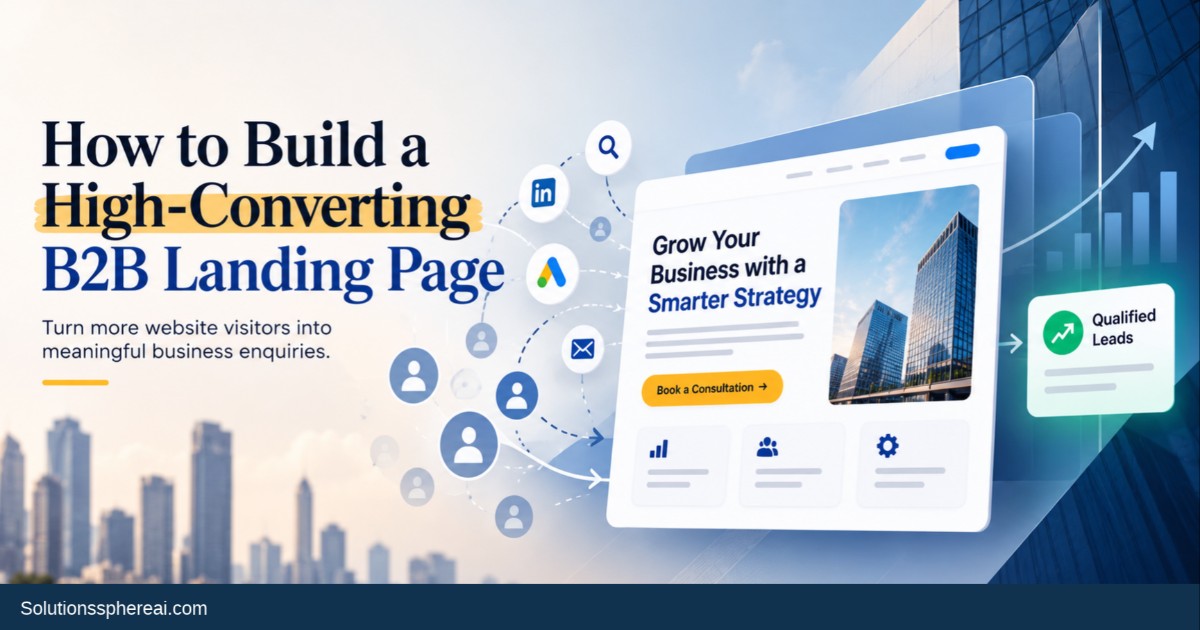
SEO can bring people who are actively looking for the answers. Google Ads can target prospects with immediate intent. LinkedIn is a great way to target specific industries and decision makers. Content marketing can establish trust before a person is ready to buy. Email marketing can keep prospects engaged over a longer sales cycle.
The landing page gives those visitors somewhere relevant to go when they're ready to take action.
If your website is getting visitors but not generating enough meaningful enquiries, the answer may not always be more traffic. Sometimes, the bigger opportunity is improving what happens after people arrive. A clearer message, a stronger offer, better proof and a simpler conversion path can change the way your existing traffic performs.
SSAI works with businesses to bring together SEO, content, performance marketing, AI-driven strategies and conversion-focused digital experiences. If you're looking for a B2B Digital Marketing Agency Bengaluru that focuses on building a stronger connection between online visibility, qualified leads and business growth, SSAI can help you create a digital strategy built around that goal.