

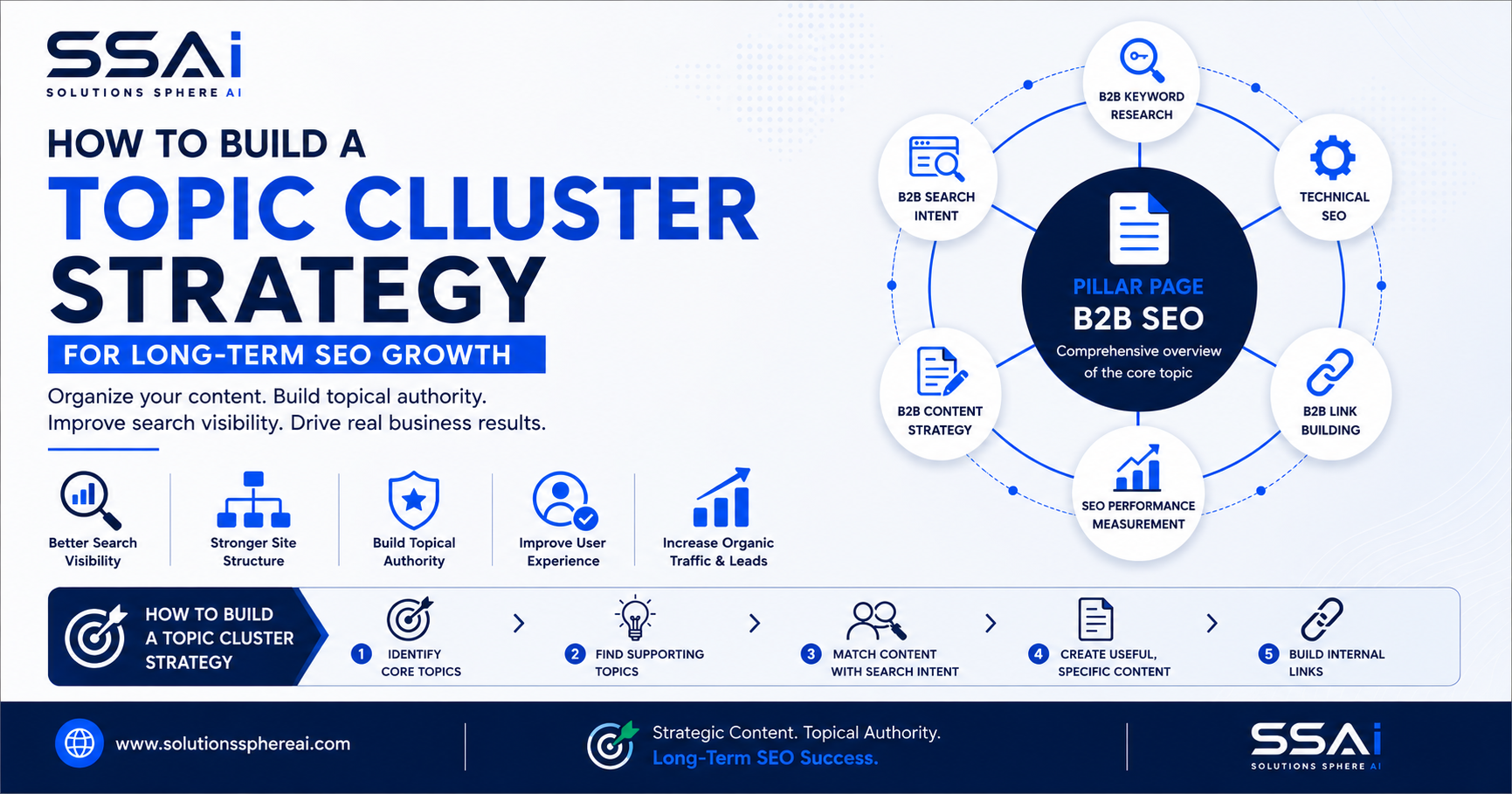
Building a topic cluster strategy will help businesses to build information architecture and topical relevance and grow with SEO over time.
Companies should not create blog posts on random and try to target hundreds of keywords. Instead, they should group topics under one central pillar page and create many related articles around it (cluster content).
What Is a Topic Cluster Strategy?
The concept of topic cluster strategy is an SEO strategy based on the creation of multiple pieces of content (supporting articles) about a certain topic or theme.
It is all about the organization of related content into coherent pieces.
As a result, businesses can create an organized collection of information on their websites and improve its ranking on search engines.
Why Topic Clusters Are Important
One of the major changes in SEO is a better understanding of search queries' context. The website that has one single article on a particular topic provides useful information. At the same time, the website that covers the same topic from multiple angles provides even more useful information.
With topic clusters, search engines understand:
- How pages relate to each other
- What the specialty of your website is
- Which page provides overview
- Which topics are important for your business
- Which pages answer specific questions
- Topic clusters also help to improve the user experience.
For example, someone who reads about B2B keyword research would like to learn about search intent and content strategy. Internal links can direct such user to the next useful resource
This way, the website retains the user while building links between pieces of content.
Pillar Pages and Cluster Content
Successful topic cluster has two major elements.
Pillar Page
Pillar page discusses broad topic in details and provides comprehensive information.
For example:
Pillar: B2B SEO
The page describes the concept of B2B SEO, its importance and major elements while providing users with directions to more detailed resources.
Cluster Content
Cluster articles discuss more narrowed topics related to pillar.
For example:
B2B SEO
B2B Keyword Research
B2B Search Intent
Technical SEO
B2B Content Strategy
B2B Link Building
Every article should discuss a specific topic and contribute to the bigger topic.
How to Build a Topic Cluster Strategy
Creation of topic cluster should start with planning, not publication.
1. Identify Your Core Topics
The starting point in building a topic cluster should be identification of topics closely related to your business, services, expertise and audience.
Topics for a B2B SEO company offering content marketing services can be, for example
• SEO
• Search visibility
• Content strategy
• Technical SEO
• AI search
• Digital PR
• B2B marketing
Your topics should not only be relevant to your business, but in demand.
A keyword with high search volume does not necessarily mean high value if it brings the wrong audience.
2. Find Supporting Topics
After choosing a central topic, divide it into smaller questions and subtopics.
For example, B2B SEO cluster can include:
• How does B2B SEO work?
• How do you find B2B keywords?
• What is B2B search intent?
• How does technical SEO affect B2B websites?
• How can B2B companies build authority?
• How should B2B SEO performance be measured?
These questions can be developed into individual cluster articles.
3. Match Content with Search Intent
Keyword research is not about only search volume.
You also need to know why people search something.
The intent of the search can be:
• Informational
• Commercial
• Transactional
• Navigational
The person who searches "what is B2B SEO?" needs information.
The person who searches "B2B SEO agency" is closer to making a purchasing decision.
The understanding of these differences helps businesses to create the content in accordance with expectations of the user and position it accordingly to his/her location in the buyer journey.
4. Create Useful and Specific Content
Each article in cluster should have a purpose.
Do not create multiple articles with essentially the same information.
Instead, create articles on different aspects of the central topic.
For example, instead of creating multiple articles on general B2B SEO, create separate articles on keyword research, technical SEO, search intent, content strategy, competitor analysis and SEO measurement.
It helps to build the depth of your website's coverage without unnecessary repetition.
5. Build Internal Links
Internal linking is the element that connects the cluster together.
The pillar page should have links to cluster articles, while the cluster articles should have links to pillar page.
Cluster articles also can have links to each other if the connection is necessary.
For example:
B2B SEO
→ Keyword Research
→ Search Intent
→ Content Strategy
→ Technical SEO
→ Link Building
It helps users to discover related information and make the connection between different pages clearer.
How Topic Clusters Help You to Build Topical Authority
Topical authority is not created by just publishing many articles.
It is created with the consistent demonstration of knowledge and relevance to the subject.
For example, the business that focuses on technical SEO can create the articles on crawling, indexing, website architecture, structured data, internal linking, JavaScript SEO, Core Web Vitals and technical audits.
When these resources are linked with the help of proper structure, the website acquires the deeper coverage of the subject.
It is what topic clusters do differently from random blog publishing.
Topic Clusters for B2B Businesses
Topic clusters are especially useful for B2B businesses, particularly when combined with a strong B2B content marketing strategy, because B2B customers usually perform extensive research before reaching out to a company.
The potential customer may perform research on a problem, then search solutions, compare providers and finally, look for the information to confirm purchasing decision.
Content can assist at each of these stages.
Awareness:
"What Is B2B SEO?"
↓
Research:
"How Does B2B Keyword Research Work?"
↓
Evaluation:
"B2B SEO vs Paid Search"
↓
Decision:
How to Measure Your Topic Cluster
Topic clusters should be measured as a whole, not individual articles separately.
The important metrics are:
• Organic Impressions
• Organic Clicks
• Keyword Visibility
• Organic Traffic
• Rankings
• Leads
• Conversion Rates
A supporting article can not bring a lot of traffic individually, but it contributes to the topic by answering specific question, providing internal links and
contributing to the bigger topic.
The goal is to measure the topic growth and business results.
Topic Clusters vs Random Blog Publication
Publication of regular blog posts does not mean content strategy.
A company can publish 50 articles on random topics and still not have the area of expertise.
Another company can publish 20 articles on a few topics and build the content ecosystem that is more relevant.
The difference is structure.
Topic cluster strategy organizes the content in connection with business goals, search intent, keywords, internal links and customer needs.
Instead of asking "What should we publish this week?", businesses should ask themselves "What topic do we need to build authority around, and what information is still missing?"
Such shift can make content strategy more effective and valuable.
How Solutions Sphere AI Approaches Content Strategy
In Solutions Sphere AI Pvt Ltd (SSAI), we believe that the content should be driven by business objectives, not publication volume.
We use keyword research, search intent, topic clustering, pillar pages, content planning, internal linking, competitive analysis and AI assisted research to create structured content strategy for long-term search visibility.
For B2B businesses ,SSAI teaches stakeholders that the goal is not only to bring traffic, but attract relevant audiences, build topical authority, improve search visibility and create content that helps buyer journey.
Topic cluster strategy helps individual pieces of content work as a big SEO system.
SEO is not about content volume.
It is about creating the right content around the right topics for the right audience.
When the content works together, not independently, it becomes a valuable asset for organic growth.