

Understanding Incrementality Testing in Digital Advertising
What Does Incrementality Testing Actually Measure?
Incrementality testing is a measurement approach to determine the actual additional value generated by a marketing campaign. Instead of looking at the total number of conversions that are attributed to an advertisement, it looks at how many conversions would not have happened if it weren’t for that advertisement. This distinction is particularly important because customers rarely make a purchase decision based on a single engagement. They might discover a brand through organic search, then go to the site via social media, get an email, and eventually convert after seeing a paid ad.
Attribution vs. Incrementality: Understanding the Difference
Traditional attribution models attempt to assign credit to these interactions. But attribution isn't causation. For example, a customer might click on an ad on Google and make a purchase. The advertising platform may attribute that conversion to the campaign. But what if the customer decided to buy the product and would have gone to the website directly? In that case, the ad may have been credited with a sale without really driving one.
The answer to this problem is incrementality testing, which compares the behavior of people who have seen the advertising with a similar group who have not. The difference in their outcomes is an estimate for the incremental contribution of the campaign. This gives marketers a more realistic view of how effective their advertising is.
Why Traditional Advertising Metrics Don't Tell the Full Story
The Limitations of Clicks, Conversions and ROAS
You’ll need to monitor metrics like click-through rate, cost per click, conversion rate, and return on ad spend to measure how your campaigns perform. However, they can sometimes present an incomplete picture of marketing effectiveness. A campaign may get thousands of clicks and hundreds of conversions but contribute very little extra revenue.
Why Remarketing Campaigns Can Overestimate Performance
Imagine a company that’s doing a remarketing campaign aimed at people who’ve visited its website. These people have expressed interest in the company’s products or services, so they are more likely to convert. If a big chunk of them go on to make a purchase, the campaign might look very successful. But some of those customers may have come back and bought without seeing another ad.
The Challenge of Measuring Multiple Advertising Channels
The problem is compounded when businesses run campaigns across multiple channels. A customer may find a company on LinkedIn, Google the name and then click a remarketing ad before making an inquiry. Each platform can claim some credit for the eventual conversion. Without knowing the additional impact of each channel, marketers run the risk of overestimating the performance of the campaign.
Incrementality testing isolates the effect of advertising from pre-existing customer demand. It doesn’t make traditional metrics irrelevant, it adds another layer of measurement to help businesses understand what their advertising is actually achieving.
How Incrementality Testing Works
Understanding Test Groups and Control Groups
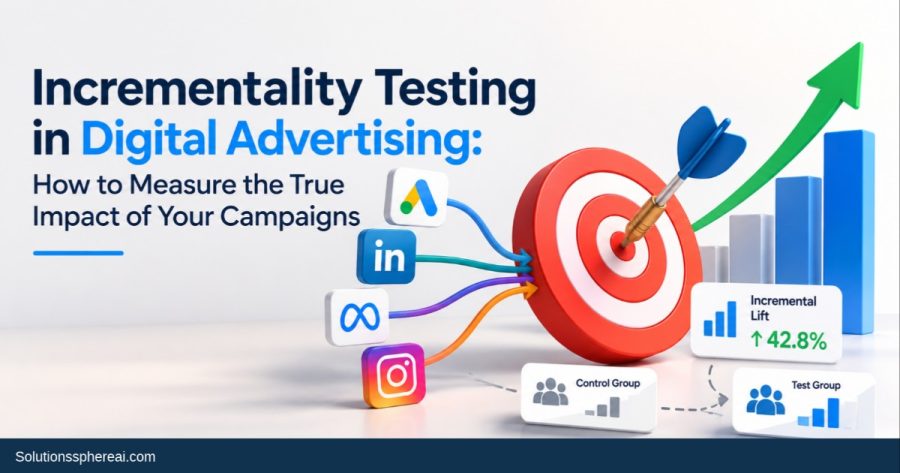
Incrementality testing is based on comparing a test group against a control group. The test group is exposed to a certain advertising campaign, whereas the control group is intentionally kept from seeing that campaign. The two groups should be as similar as possible in terms of audience characteristics, purchasing behavior, geography and other relevant factors.
After the campaign has been running for a set period of time, marketers compare the conversion results of the two groups. If the exposed group generates more conversions than the control group, the difference is the estimated incremental impact of the advertising campaign.
A Practical Example of Incrementality Testing in B2B Advertising
Let’s imagine a B2B company that is running a LinkedIn ad campaign to generate inquiries for its software solutions. The test group consists of 10,000 eligible professionals exposed to the advertisements, and another 10,000 comparable professionals in the control group.
For example, say in the same measurement period the test group gets 500 conversions and the control group gets 350 conversions. 150 extra conversions may have happened because of advertising that might not have happened without it.
How to Calculate Incremental Lift
The incremental lift can be calculated as follows:
Incremental Lift (%) = (Test Group Conversion Rate – Control Group Conversion Rate) / Control Group Conversion Rate * 100
Conversion rate in the test group is 5%, and in the control group – 3.5% in our case. This means an incremental lift of ~42.86%.
This means the campaign delivered a tangible lift in conversions relative to the control group. The business now has more robust evidence of the actual contribution of the campaign, rather than relying solely on the advertising platform’s reported conversions.
Different Types of Incrementality Testing Marketers Can Benefit From
Audience-Based Holdout Testing
One of the most common is the audience-based holdout test This method randomly excludes a percentage of the eligible audience from receiving campaign ads. Their behavior is then compared to the exposed audience. This approach is especially helpful when it comes to remarketing, customer acquisition and audience specific campaigns.
Geographic Incrementality Testing
Another approach is geographic incrementality tests. Marketers don’t divide people into groups; they divide places into test markets and control markets. In some locations advertising is shown while similar locations are exposed to little or no advertising in the campaign being tested. Businesses are then able to compare differences in inquiries, sales, website activity or other business outcomes. This approach is useful where audience-level randomization is difficult or unavailable.
Conversion Lift Experiments
Another practical approach is conversion lift experiments. There may be experiments embedded in the advertising platforms to measure whether exposure to ads leads to additional conversions. These experiments can help in testing with audience segmentation and measurement capabilities within platform. But before marketers can trust the results, they need to understand how the experiment was conducted, what its limitations are, and how the results are presented.
Sequential Testing Across Advertising Channels
Sequential testing is also useful for companies with several advertising channels. Marketers can test individual channels or campaigns over different time periods as long as they factor in seasonal variations, demand fluctuations and other outside forces. Although this calls for careful planning, it can help to find out which channels add meaningful incremental value.
Why Incrementality Testing Is Crucial in B2B Marketing
Understanding the Complex B2B Buying Journey
In the B2B marketing world, incrementality testing may be even more valuable, as the buying journey is generally longer with multiple decision-makers involved. A potential customer might see an ad on LinkedIn, download a whitepaper, attend a webinar, visit the company’s website multiple times and eventually request a product demo.
Measuring the Influence of Awareness Campaigns
In such cases, the last click attribution to the last clicked ad does not show the full picture of marketing activities’ influence. Some campaigns may not drive immediate inquiries but may help to introduce the brand to decision makers or prompt prospects to engage with the business later.
For instance, a B2B business running LinkedIn awareness campaigns could see an increase in direct website visits and branded search activity during the campaign period. But these changes alone do not prove advertising caused the increase. A well structured incrementality experiment can help understand if the campaign drove incremental qualified inquiries or other business outcomes.
Measuring Beyond Lead Generation
It’s also important to measure beyond lead volume. Some B2B metrics you can keep track of are: marketing qualified leads, sales qualified leads, demo bookings, opportunities created, pipeline value and closed revenue. A campaign that generates fewer leads may actually yield more incremental business value if the leads are more likely to close.
Common Problems with Measuring Incremental Advertising Impact
Creating Comparable Test and Control Groups
Incrementality testing will tell you something, but a good experiment requires a bit of planning. Building comparable treatment and control groups is one of the biggest challenges. If the groups differ significantly in purchase intent, location, demographics, or prior brand engagement, the results may not accurately reflect advertising impact.
Dealing with Small Sample Sizes
Sample size is also important. Smaller campaigns may not have enough conversions to have a statistically significant difference between groups. In these cases, marketers may need to extend the experiment, increase the eligible audience, or choose a more frequent intermediate conversion event.
Accounting for External Factors
External factors can also play a role in the outcome. Other factors outside of advertising may affect conversion rates - seasonality, competitor activity, discounts, new product launches, economic factors, changes in sales processes, etc. These considerations are relevant to the design and interpretation of experiments.
Managing Privacy and Tracking Limitations
Privacy restrictions and limited tracking ability are other challenges. Browser tracking, consent requirements and changes in platform data availability make it difficult to consistently identify users across channels. Businesses should therefore rely on privacy-conscious measurement methods and not treat the incomplete platform data as a complete representation of customer behavior.
Understanding Statistical Significance
And most of all, marketers should resist the temptation to assume that every positive difference is evidence of success. When analyzing results, statistical significance, experiment design, confidence intervals, and practical business impact are all important.
How Businesses May Utilize Incrementality Understandings to Boost Campaign Performance
Identifying Campaigns That Generate Genuine Results
The real value of incrementality testing lies in how businesses use the insights. If a campaign is generating strong attributed conversions but little incremental lift, it may be time for marketers to re-evaluate their targeting strategy, bidding approach or budget allocation. They may be spending big on audiences that are already likely to convert.
Conversely, a campaign with relatively modest reported conversions may have a strong incremental impact. Such campaigns deserve a closer look as they may be reaching audiences who would have never known about the business otherwise.
Making Smarter Advertising Budget Decisions
Businesses should also use incrementality knowledge to compare advertising channels. Marketers can look at which channels are driving incremental conversions, qualified leads and revenue, rather than allocating budgets based only on reported return on ad spend. This is where performance marketing companies in india can help businesses make informed advertising decisions by focusing on campaign effectiveness, measurable outcomes and better budget utilisation. This encourages a more balanced approach to marketing spend.
Making Incrementality Testing an Ongoing Process
Incrementality testing is not one and done. Consumer behavior, competition, audience quality and ad costs change over time. Regular testing helps businesses identify changes in the performance of their campaigns and determine if their current marketing strategies are still delivering real value.
Incrementality Testing for a Smarter Digital Advertising Strategy
Digital advertising has moved beyond just getting more impressions, clicks, or conversions. Companies need to know if their marketing efforts are delivering quantifiable gains in new customers and sales. Incrementality testing provides a more reliable way to answer that question by separating conversions that are associated with advertising from conversions that are actually generated by it.
For businesses in competitive markets this distinction can make a big difference. It drives marketers to question assumptions, examine the effectiveness of campaigns and invest in strategies that provide more business value. When you pair incrementality testing with attribution modeling, conversion tracking, analytics, and ongoing experimentation, it becomes a key part of a data-driven marketing strategy.
At SSAI, we believe that successful digital marketing begins with understanding what drives meaningful business results. We are a B2B Digital Marketing Agency Bengaluru that assists businesses in creating smarter marketing strategies through data-driven insights, performance measurement, and continuous optimization. Because the best advertising isn’t about how many people see your campaigns, it’s about how much extra value your campaigns create for your business.
A B2B performance marketing agency that builds incrementality testing into its reporting can tell a business which campaigns are genuinely driving new conversions, rather than simply claiming credit for sales that would have happened anyway.