

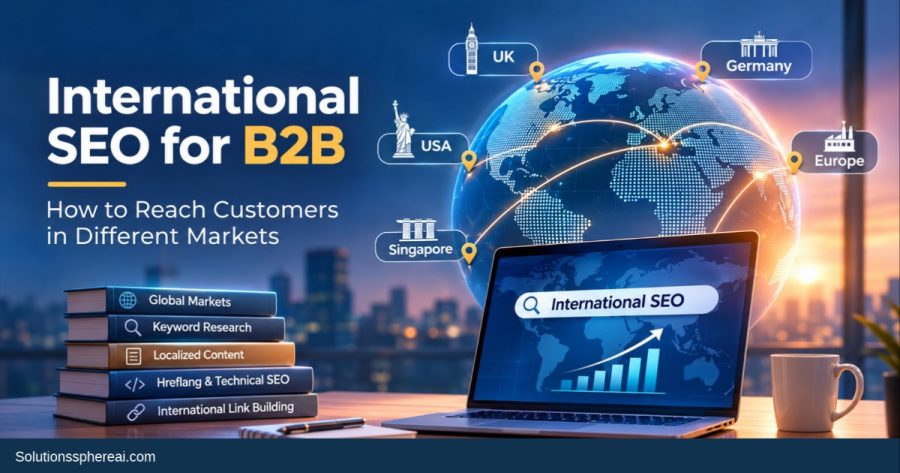
International SEO: A Guide for B2B Companies
International SEO is the process of optimizing your website so search engines know which country and language audiences your content is intended for. Traditional SEO tactics are usually aimed at getting noticed in a certain market. International SEO takes into account the differences between various geographic locations.
These differences can directly impact lead generation for B2B companies. Think of a manufacturing company that wants to attract buyers from Europe and North America. The same products might be sold but the information that potential customers want could be different depending on where they are. Buyers in Europe may be more interested in regulatory compliance and sustainability standards, whereas buyers in North America may place more importance on production capacity, pricing and supply chain reliability.
Publishing the same content for all markets might not be the best way to approach these differences. International SEO helps a business optimize its website, keywords and content for what local audiences are really searching for. This helps to engage with relevant buyers and to build credibility in unknown markets.
How to Select the Right International Markets for Expansion
One of the biggest mistakes that businesses make with international SEO is trying to target too many countries at once. While it’s tempting to think about a global audience, when you spread your resources across a number of markets without really knowing their potential, it can make your strategy difficult to manage.
It is better to locate countries where there is real demand for the firm's products or services. Businesses should decide where to focus based on industry growth, search demand, existing international inquiries, competition and purchasing potential.
Tools such as Google Analytics and Google Search Console can help you identify countries that are already driving website traffic and search impressions. SEMrush can help you learn more about regional keyword opportunities and what your competitors are doing.
For example, if a B2B tech company in Bengaluru is already receiving inquiries from Singapore and the United Kingdom, then these markets could be worth pursuing. Instead of going for ten countries right away, the company can focus on learning these two markets, build the right landing pages and get visibility for the services local businesses are looking for.
Starting with fewer promising markets allows companies to leverage their marketing resources better and lay a stronger groundwork for future expansion.
Do Keyword Research Based on Local Search Behavior
Keyword research is one of the most important parts of international SEO, but it is also where many businesses make mistakes that could have been avoided. Companies often think that translating their current keywords into another language or using the same English keywords in different countries will be enough.
Unfortunately, people do not always search for the same products and services in the same manner.
For example, a business in the United States may use different industry terms than a business in the United Kingdom, even if they are looking for the same service. The differences are even more pronounced when targeting non-English speaking markets.
B2B companies should do keyword research by country. That means knowing the local terms, search volume, keyword difficulty, search intent and commercial relevance. It is as important to determine if users are seeking general information, comparing service providers or actively searching for a solution.
For example, an enterprise software company shouldn’t just target generic keywords about its product. It should also look at industry-specific searches, solution-based queries and keywords that show purchase intent.
The intention here is not just to find keywords that have a high search volume. It’s to determine what terms potential customers are most likely to use when researching, evaluating and purchasing B2B solutions.
Choose the Best Website Structure for International SEO
Your website structure is a key part of helping search engines understand your international targeting strategy. When a business starts to expand into multiple countries it has to make decisions about how to structure regional content.
There are three approaches in common use.
Country code top-level domains (ccTLDs) are country-specific domains like example.co.uk for the United Kingdom or example.de for Germany. These provide clear geographical cues, but may require additional resources to maintain and establish authority on separate domains.
Subdomains separate content by region in separate sections such as uk.example.com and de.example.com. This approach gives you flexibility in managing different markets, but you have to think about how you manage authority and technical signals across those sections.
Subdirectories place regional content on the main website, e.g. example.com/uk/ or example.com/de/. This structure enables businesses to organize international pages under a primary domain.
There isn't a universally applicable structure for all companies. It is contingent upon how many markets you are targeting, the resources you have available, the infrastructure of your website, and your plans for long-term growth.
For businesses that are slowly entering international markets, subdirectories can be a realistic first step, as regional content can be more easily organized and managed under one domain.
Improve Country and Language Targeting with Hreflang Tags
Technical SEO is especially important when a website has multiple language or country versions. One of the most useful tools in this process is the hreflang attribute.
Hreflang tags tell search engines the language and the target geographic audience of different versions of a webpage. For example, a company with audiences in the U.S. and the U.K. might have separate English-language pages for each country. Hreflang tags tell people which version you want them to view.
This is useful because English language content does not mean that the same page will work across all English speaking markets.
However, hreflang implementation is not one that is done easily. Technical problems can also occur with incorrect language codes, missing return tags, and inconsistent use of URL references. You also need to set up canonical tags carefully so you don't accidentally tell Google that the regional pages should all be collapsed into one version.
Businesses should conduct regular technical SEO audits of their international website structure to identify these issues before they affect search visibility.
Develop Localized Content That Engages International Buyers
One key way to improve your international search visibility is to produce content that actually speaks to the needs of each market you are targeting.
Rarely is it enough to simply translate an existing blog or change a few keywords. International customers want information relevant to their industries, challenges, regulations and business environments.
For example, a B2B company targeting European manufacturers may publish articles about local manufacturing trends, sustainability requirements, and supply chain challenges. A tech firm aiming to tap into the U.S. business market may target software integration, operational efficiency and improved ROI.
Regional landing pages, industry-focused blogs, case studies, customer testimonials, and research reports are all ways to help businesses build a stronger connection with international audiences.
It’s important to be consistent with brand messaging as well. The examples, terminology and information may vary by market, but the company’s core value proposition should be recognizable.
Good localization means that international visitors feel that the business understands their requirements, rather than just trying to sell the same service to everyone.
Build Relevant Backlinks to Increase Your International Authority
A successful website in its home market can still be faced with stiff competition when entering a new country. This is because established local businesses are more likely to have better brand recognition, relevant backlinks and a more developed online presence in the industry.
International link building allows companies to build authority with links from relevant websites in their target markets.
B2B companies can try to find opportunities in industry publications, regional business directories, professional associations, trade websites and business partnerships. Also, participating in international exhibitions, publishing original research and offering expert opinions to industry publications can also provide valuable backlinks.
But link building should never be a numbers game. Building backlinks from irrelevant websites simply to add to your backlink volume is unlikely to help you support a sustainable SEO strategy.
A relevant backlink from a well-known industry publication in the target country is worth many times more than multiple links from sites with little relevance to the business.
Enhance Website Experience for International Visitors
But attracting international traffic is only a part of the process. Visitors to your site should be able to find the information they want without sifting through irrelevant clutter.
Picture a potential customer in Germany visiting your website and finding only Indian contact details, pricing tailored to that region and examples that have no relevance to their market. Even if your website has a good ranking, these gaps could be the reason why the visitor does not submit an inquiry.
Businesses should enhance their websites to be easier to navigate with relevant regional contact information, the right currencies, local testimonials, clear service descriptions and accessible inquiry forms.
The website needs to perform well too. When visitors from different parts of the world access your website, slow loading pages can affect the experience. Image optimization, mobile responsiveness, reliable hosting and content delivery networks can all improve loading times.
Companies also should not automatically redirect visitors based on IP address. By giving users the option to choose their preferred country or language, the experience becomes more flexible and they can access alternative regional pages.
How to track International SEO performance (without using traffic)
More international traffic to the website may seem like a good result, but it doesn’t necessarily mean that the strategy is producing business opportunities.
The real goal for B2B companies is to attract visitors who are potential customers.
Businesses should be monitoring organic impressions, keyword rankings, click-through rates, engagement, inquiries, qualified leads and conversions by country. Google Search Console can show you which search queries and pages are generating visibility in different markets, while Google Analytics can give you insights into visitor behavior and website interactions.
Combining these insights with CRM data can also shed more light on your international SEO performance. Companies can see which countries are generating the most qualified inquiries, which landing pages are helping conversions and where potential customers drop out of the buying journey.
This helps to understand which markets to focus on more and where the current strategy needs to be improved.
Transform International Search Visibility into Long-Term Business Growth
There is no quick win in growing into international markets using SEO, it takes time, consistency and a clear understanding of customer behavior. Businesses must establish authority in new markets, develop relevant content, meet technical requirements and constantly assess how their audiences engage with their websites.
The best international SEO strategies aren’t just a one-size-fits-all approach in every country. They know that each market has its own search behavior, competition, and expectations.
This opens up opportunities for B2B companies to develop stronger relationships with international decision-makers and generate sustainable organic visibility. Regional keyword research, technical SEO, localized content and appropriate link-building efforts can help businesses build a more robust presence across multiple markets.
Businesses looking to improve their search visibility across domestic and international markets can benefit from working with a B2B SEO Agency that understands the importance of targeted keywords, technical optimisation and relevant content. Investing in effective SEO Services Bengaluru can also help companies strengthen their online presence, attract relevant audiences and build a sustainable foundation for organic growth.
SolutionsSphereAI (SSAI) is a mixture of strategic SEO and digital marketing to help companies increase their digital presence and reach the right audiences for measurable business growth. As a B2B Digital Marketing Agency Bengaluru, we at SSAI help businesses grow their online presence, engage with the right audience and build a stronger foundation for lasting growth.
GEO services for businesses expanding into new markets are becoming just as relevant as traditional international SEO, since AI search tools are increasingly part of how buyers in different regions research vendors.