

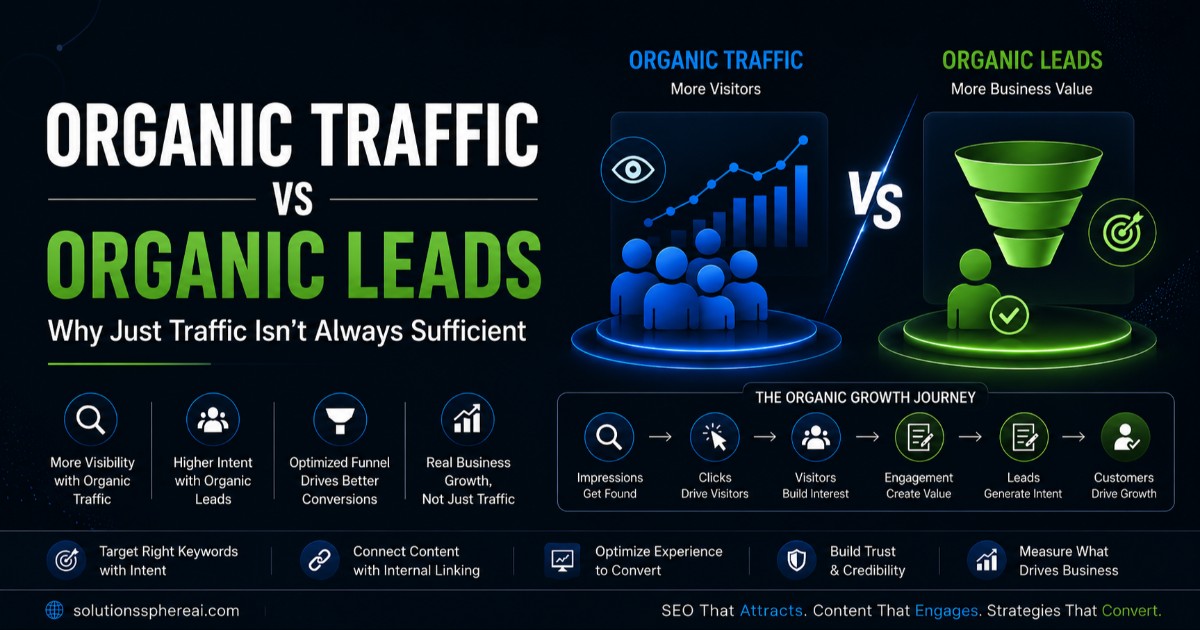
What Is Organic Traffic?
Organic traffic refers to visitors who find your website through unpaid search engine results. When someone searches Google for a product, service, question, or solution and clicks on your website, that visit is counted as organic traffic. For example, if someone searches for “digital marketing agency in India,” finds your website in the results, and clicks through, that person becomes part of your organic traffic.
One of the biggest advantages of organic traffic is that you don't have to pay for every individual visit. Unlike paid advertising, where you generally pay for clicks or impressions, a well-optimized page can continue attracting visitors after it starts ranking. This makes SEO a valuable long-term marketing channel and allows businesses to build visibility over time.
However, traffic only tells you that people are arriving at your website. It doesn't necessarily tell you whether those people are interested in your business. A website might receive 50,000 visitors every month, but if a large percentage of them are students, researchers, job seekers, or people looking for something unrelated to your services, that traffic may have very little commercial value.
What Are Organic Leads?
Organic leads are visitors who discover your business through unpaid search and then take an action that shows genuine interest. The exact action depends on the type of business. A B2B company may consider a demo request or consultation booking a lead, while a service business may focus on contact forms and phone calls. For a SaaS company, a free-trial registration could be an important lead-generation action.
The key difference is intent. Transactional content can target people who are ready to act. SEO can work alongside Performance Marketing & paid advertising B2B and B2C can capture demand at different stages of the customer journey, allowing businesses to build both long-term organic visibility and immediate lead-generation opportunities. This is why organic leads have a more direct connection to business growth. Organic traffic tells you who is visiting your website, while organic leads tell you who may be interested in doing business with you.
Organic Traffic vs Organic Leads: What’s the Difference?
Both metrics are useful, but they answer different questions. Traffic helps you understand whether your SEO strategy is increasing visibility and attracting an audience. Leads help you understand whether that audience includes people who are genuinely interested in your offering.
This means a website with 10,000 highly relevant visitors could potentially be much more valuable than a website with 100,000 visitors who have little commercial intent. Traffic itself isn't the problem. The problem is treating traffic as the final measure of SEO success.
When Content Gets Traffic but Doesn't Generate Leads
SEO and content marketing work closely together. Useful content can attract visitors, answer questions, build authority, and introduce your brand to people who may eventually need your services.
However, many businesses make the mistake of creating helpful content without thinking about what should happen after someone finishes reading it. Imagine someone lands on an article about improving website SEO. They read the entire article and find it useful. They now understand the topic better, but there is no relevant service link, no useful resource, no case study, and no clear next step.
The visitor simply leaves.
The content has succeeded in generating awareness and traffic, but it hasn't created a business opportunity. A better customer journey could look like Learn → Explore → Compare → Enquire → Convert.
The goal isn't to push every visitor into making a purchase. Instead, your content should make the next relevant step easy to find. That could be a service page, case study, downloadable resource, SEO audit, or consultation.
Search Intent and Landing Pages Matter
Another reason organic traffic doesn't always convert is a mismatch between search intent and landing-page content. Imagine someone searches for “SEO pricing in India.” They are probably looking for information about pricing, packages, what's included in an SEO service, and the factors that influence cost. If that person lands on a generic homepage, they may have to search through several pages before finding the information they need.
Even if your company offers exactly the service they're looking for, that disconnect can be enough to make them leave. When the keyword, search intent, landing page, and call to action all work together, visitors have a much clearer path toward conversion.
Your Website Experience Can Make or Break Conversions
Sometimes the SEO strategy is working well. Your website is attracting relevant visitors, your rankings are improving, and people are finding your pages through Google. Yet the number of enquiries remains low.
A page that loads slowly can cause visitors to leave before they even read the content. Complicated navigation can make it difficult to find important information. A weak headline may fail to communicate the value of your service. A long enquiry form may discourage people from submitting their details. Poor mobile design can create another layer of friction. In simple terms, SEO gets people to your website, but the website experience helps determine whether they stay and take action.
The Organic Traffic-to-Lead Funnel
Rather than looking at traffic in isolation, it is more useful to look at the complete customer journey. A simple organic search funnel can be understood as Impressions → Clicks → Visitors → Engagement → Leads → Qualified Leads → Customers.
The next stage is lead generation. Are visitors filling out forms, booking consultations, requesting demos, making calls, or taking another meaningful action? Qualified leads take this one step further by showing whether those enquiries actually come from people who fit your target audience.
Organic search is not the only channel businesses can use to generate these opportunities. Performance Marketing & Paid Ads can help capture demand through targeted campaigns, while SEO builds long-term visibility and attracts users through unpaid search. Together, these channels can support a more balanced customer acquisition strategy..
How to Turn Organic Traffic Into Organic Leads
The first step is to create content based on search intent rather than simply creating content around keywords. Informational content can help people who are still learning about a problem. Commercial content can help people compare different solutions, while transactional content can target people who are ready to take action.
Calls to action should also be relevant to the content. For an article about SEO audits, “Get a Free SEO Audit” is likely to be more useful than a generic “Contact Us” button. Similarly, a PPC cost guide could invite readers to “Talk to a PPC Specialist.”
The best CTA is often the one that feels like a natural next step rather than an interruption.
Internal Linking Can Support Lead Generation
Internal linking is another effective way to connect traffic-generating content with conversion-focused pages. For example, a blog about improving local SEO could link to a detailed local SEO checklist. That checklist could then direct readers to a local SEO service page, where they can explore case studies and eventually request a consultation.
The journey becomes Educational Content → Valuable Resource → Service → Trust → Enquiry.
This approach turns your website into a connected system instead of a collection of individual pages. Your blog posts aren't simply there to generate traffic; they can also help move interested visitors further along the buying journey.
Which SEO Metrics Should You Track?
Organic traffic should absolutely remain part of your SEO reporting. It helps you understand whether your website is gaining visibility and attracting visitors from search.
You can track impressions, keyword rankings, search visibility, and organic clicks to understand visibility. Engagement metrics can help you see whether visitors are actually interacting with your content. Lead metrics such as form submissions, phone calls, demo requests, consultation bookings, and organic conversion rates tell you whether your traffic is creating opportunities. The final step is connecting SEO to business results. Where possible, track qualified leads, pipeline value, customers acquired through organic search, customer acquisition cost, and revenue generated or influenced by SEO.
How Solution Sphere Can Help
If your website is already getting organic traffic but your enquiries aren't growing at the same pace, the answer may not be to simply chase more visitors. Sometimes, the bigger opportunity is to make better use of the traffic you already have.
The Solution Sphere AI concentrates on SEO tactics that help connect search visibility with lead generation. Instead of choosing keywords solely because of their high volume, the focus of Solution Sphere AI is to find relevant, high-intent searches. For businesses exploring performance marketing India strategies, combining organic search with targeted paid campaigns can create a more complete approach to customer acquisition. Businesses looking for digital marketing Bengaluru solutions can also benefit from integrating SEO, paid campaigns, and conversion-focused strategies into a unified marketing approach.
With Solution Sphere, SEO isn't just about getting found. It's about helping the right customers find you—and giving them a reason to take the next step.