

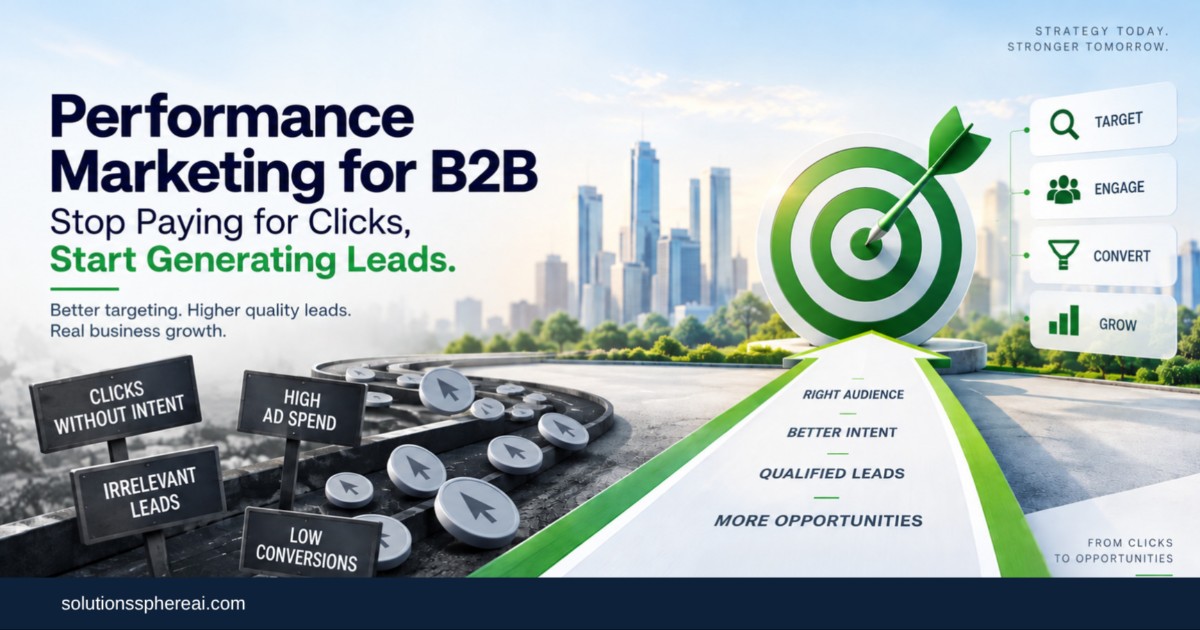
Performance marketing sounds simple from the outside. You put an advertisement in front of the right audience, people click on it, some fill out a form, and you get leads. The numbers are easy to track, and platforms like Google and LinkedIn give you plenty of data to work with. But anyone who has worked in B2B marketing knows the reality is different. You can generate hundreds of clicks and still struggle to get a meaningful sales conversation. You can also generate plenty of leads and discover that most of them have little or no buying intent. That is where a more focused B2B approach becomes more important. The goal should not simply be to get more people to click. It should be to attract the right people and move them towards a genuine business opportunity.
Why B2B Performance Marketing Is Different
B2B buying is rarely an impulse decision. When a company is looking for industrial equipment, software, consulting services, technology, or another high-value solution, there is usually a lot of research involved. People compare suppliers, read websites, look at case studies, speak to colleagues, discuss budgets, and often involve several people before making a decision. The person who first clicks on your advertisement may not even be the person who makes the final purchase decision. They could be researching on behalf of their company and sharing the information with a technical team, procurement department, manager, or business owner.
Because of this, the B2B buying journey can stretch over weeks or months. Someone might discover your brand through LinkedIn today, read one of your blogs next week, search for your service on Google later, visit your website again, and finally submit an enquiry much later. A performance marketing strategy that only looks at what happens immediately after an advertisement is clicked is missing a large part of the picture.
A Click Does Not Mean Buying Intent
One of the biggest mistakes businesses make is assuming that a click automatically represents interest. It does not. A click only tells you that someone interacted with your advertisement. It does not tell you whether that person is a potential customer.
Imagine a company selling industrial cooling solutions. Someone searching for “what is industrial cooling” might click on an advertisement because they are researching the subject. Another person searching for “industrial chiller supplier India” is showing a much stronger commercial signal. Both searches can generate traffic, but their potential business value is very different.
This is why performance marketing should pay attention to search intent, audience quality, and the reason behind the interaction rather than simply celebrating a high click-through rate. The objective is not to attract everyone who might be interested in a topic. It is to reach people and businesses that have a genuine reason to consider the solution.
Cheap Clicks Can Become Expensive Leads
This is where focusing too heavily on cost per click can become misleading. A low CPC can look attractive in a campaign report, but cheaper traffic is not necessarily better traffic.
If you spend ₹20 on a click from someone who has no intention of buying, that click may be worth very little. If you spend ₹100 on a click from a decision-maker who works for a company that fits your ideal customer profile and is actively looking for your solution, that click could eventually lead to a much larger opportunity.
The second click looks more expensive on the advertising dashboard, but it may be far more valuable to the business. B2B performance marketing therefore needs to look beyond the initial cost of acquiring traffic and ask whether that traffic has the potential to become commercially meaningful.
Not Every Lead Is a Good Lead
The same problem appears when businesses focus too heavily on the number of leads generated. Suppose one campaign generates 200 leads while another generates only 50. It would be easy to assume the first campaign performed better.
But what happens when sales starts contacting those leads?
Perhaps most of the 200 leads are students, job seekers, irrelevant companies, people outside the target geography, or businesses with no immediate need. Meanwhile, the smaller campaign may have generated 50 leads from companies that genuinely need the product and are ready to have a conversation.
This is why B2B performance marketing should not stop at lead generation. Lead quality, Marketing Qualified Leads, Sales Qualified Leads, opportunity creation, lead-to-opportunity rate, pipeline value, and customer acquisition cost can provide a much clearer picture.
A ₹500 lead is not automatically better than a ₹2,000 lead. The more important question is what happens after the lead enters the sales process.
Your Landing Page Is Part of the Campaign
Getting someone to click on an advertisement is only half the job. What happens next matters just as much.
A common mistake is sending every paid visitor to a generic homepage and expecting them to find their way around the website. Someone who clicked an advertisement for a particular product or business problem should ideally land on a page that continues the same conversation.
If the advertisement talks about reducing manufacturing downtime, for example, the landing page should immediately address that problem and explain how the company's solution can help. It should provide enough information to build confidence, demonstrate relevance, and give the visitor a clear next step.
That next step does not always have to be “Contact Us.” Someone discovering your company for the first time may want to read a guide or case study. A prospect who has already visited your product pages several times might be ready for a consultation or demonstration. Giving prospects different ways to engage makes the journey feel more natural.
Marketing Needs to Know What Happens After the Lead
One of the biggest opportunities for B2B companies is connecting marketing data with sales data.
Many businesses know how many clicks their campaigns generated and how many people filled out a form. But they do not always know what happened afterwards. Did sales contact the prospect? Was the company relevant? Did the conversation turn into an opportunity? Was a proposal sent? Did the opportunity eventually become a customer?
Without these answers, marketers are working with only half the information.
A campaign might appear successful because it generates inexpensive leads, while another campaign that produces fewer leads may actually be responsible for much more valuable sales opportunities. Connecting advertising platforms with CRM and sales data allows marketers to understand which campaigns are generating genuine business potential.
Google, LinkedIn and Retargeting Have Different Roles
Different advertising platforms can play different roles in a B2B strategy. Google Ads can be useful when someone is already searching for a product, service, supplier, or solution. The search itself can provide an important indication of intent.
LinkedIn works differently. It allows B2B marketers to reach professional audiences based on factors such as industry, job role, seniority, and company characteristics. This makes it useful when a business knows exactly which types of companies and decision-makers it wants to reach.
Then there is retargeting. Someone may visit your website without filling out a form. That does not necessarily mean they are uninterested. They may simply not be ready. A well-planned retargeting campaign can bring that prospect back with a case study, useful content, product information, or another relevant message.
The important thing is not to make every platform do the same job. Each channel should have a clear role within the larger customer journey.
Content Can Make Paid Advertising More Effective
B2B buyers usually have questions before they have confidence. They want to understand the problem, explore possible solutions, compare alternatives, and make sure they are dealing with a company that understands their industry.
This is where content becomes important. Blogs, case studies, industry reports, technical guides, webinars, comparison articles, videos, and solution pages can help answer those questions. Paid advertising can then bring the right audience to that content.
Someone who is still researching may not respond to a sales-heavy advertisement, but they may spend several minutes reading a useful industry article. Another prospect who has already visited several product pages may be more receptive to a consultation or demonstration.
Not every interaction needs to produce an immediate lead. Sometimes marketing simply needs to give a potential buyer enough information and confidence to take the next step later. Looking to generate better-quality leads through paid advertising? Get in touch with Performance Marketing Bangalore agencies to help with your demands.
Capturing Demand Is Only Part of the Job
There is another important distinction between capturing demand and creating demand. Some people are already looking for a solution and simply need to find the right company. Others may not be actively searching yet but could eventually need the product or service.
Expecting every advertisement to generate an immediate lead ignores this difference. A prospect might see a LinkedIn advertisement today, read a blog next week, visit the website a few weeks later, and finally search for the company when they are ready to speak with a supplier.
That first advertisement may not receive credit for the final conversion in a simple reporting dashboard, but it may still have played a role in making the company familiar to the buyer.
This is why B2B performance marketing needs both short-term conversion thinking and a longer-term understanding of how demand develops.
From Paying for Clicks to Generating Opportunities
Ultimately, good B2B performance marketing is about making the entire journey work better. It is about understanding who the business actually wants to reach, identifying the intent behind searches and interactions, creating advertisements that speak to real problems, sending people to relevant landing pages, providing useful content, and learning from what happens after a lead reaches the sales team.
Sometimes that means changing the audience. Sometimes it means changing the offer, landing page, keyword strategy, or messaging. And sometimes it means accepting a higher cost per lead because the leads being generated are far more valuable.
At Solutions Sphere AI, we look at B2B performance marketing as more than a way to buy traffic. The focus is on building a connected journey between advertising, content, website experiences, lead generation, and sales. Getting 1,000 people to click on an advertisement may look impressive on a dashboard, but it does not necessarily mean the campaign is creating business value. Ten relevant prospects having genuine conversations with your sales team can mean much more.
SSAI believes that in B2B performance marketing, the real measure of performance is not how much you pay for a click. It is what that click has the potential to become.