

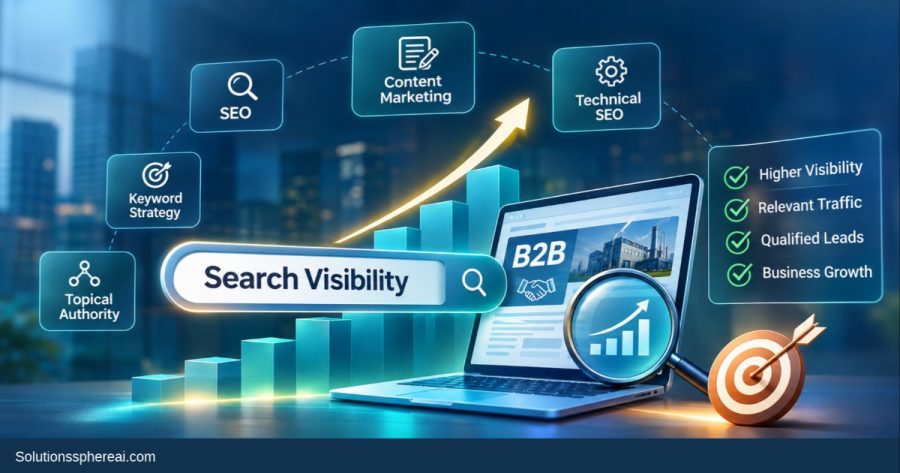
Search Visibility refers to the ease with which a business can be found on search engines when a prospective customer is searching for related products, services, information or industry solutions. B2B companies have to improve their visibility more than just getting higher rankings for common keywords. This means creating a consistent online presence, publishing useful content, building topical authority, improving website performance and making sure the right audience can find the business at different points in their buying journey.
A well-planned search visibility strategy enables companies to attract the right organic traffic, build trust, generate qualified leads and create long-term digital growth. Rather than relying solely on paid advertising, companies can create a sustainable online presence by making their expertise searchable.
A Look at Why Search Visibility Matters for B2B Businesses
B2B buying decisions are rarely made on the fly. Unlike many consumer purchases, business transactions often have multiple decision-makers, extensive research, budget constraints and longer sales cycles. A prospective customer may surf several websites, compare service providers, read educational articles and visit a company’s website a few times before initiating a conversation.
If a business is absent at the time its target audience is looking for related information, it loses opportunities to competitors that have invested in their digital presence. Good search visibility helps companies become part of the buyer’s research process before a direct sales interaction takes place.
It also helps to build brand recognition. When a company shows up consistently for industry-specific search queries, users start to link the brand with particular services and areas of expertise. Repeated exposure over time can increase credibility and familiarity in the mind of the buyer when they get to the point of making a decision.
Build a Business Intent-Based Keyword Strategy
Understanding what your potential customers are searching for is the foundation of a good search visibility strategy. Businesses need to identify keywords, questions and phrases used by their audience when looking for solutions. However, solely targeting high-volume keywords can lead to attracting visitors with no genuine interest in the company’s actual services.
When conducting B2B keyword research, you need to consider search intent, i.e. the reason why a search query is made. Some users want general information, some want to compare providers, and some want to buy a service. Someone searching for what technical SEO is may be doing early-stage research, while someone searching for B2B SEO agency is likely comparing potential partners.
Business: Develop a balanced keyword strategy of informational, commercial and transactional searches. Long-tail keywords are especially useful because they tend to be more specific and draw more relevant traffic. The mix of service-related keywords with industry-specific terms, geographic terms and problem-oriented searches allows businesses to target prospects at different levels of buying intent.
The same applies to keyword placement. Search terms should fit meaningfully into page titles, headings, introductions, URLs and website content without losing readability. The goal is to produce content that actually answers real questions, not just to repeat keywords to game the rankings.
Establish Topical Authority Through Consistent Content
The most effective way for B2B companies to improve their search presence is to consistently publish useful content. Search engines are trying to provide useful and relevant information, so having comprehensive content is a key part of a good SEO strategy.
Instead of publishing scattered articles on unrelated topics, businesses should concentrate their content on key themes in their industry. This helps build topical authority because it shows you know different aspects of a particular subject.
For example, a digital marketing agency could write a main article on B2B SEO strategy and then write complementary articles on keyword research, technical SEO, content optimization, internal linking, search intent, local SEO, and organic lead generation. Each support article should cover its topic in adequate detail and link naturally to relevant pages on the site.
This interconnected structure forms a topic cluster. The main article provides the big picture . Supporting articles address specific questions in more detail . The two together provide a more complete information resource for the reader and make it easier for search engines to understand the relationship between different pages.
Consistency is also important. Publishing one long-form article and then going dark for a few months can diminish the long-term benefits of content marketing. This means companies can grow their knowledge base online, over time, in a sustainable way, with real updates and research.
Improve Your Website Structure and On Page SEO
Even high quality content can struggle to perform if the website is hard to navigate or is poorly organized. A good website structure is important for visitors and search engines to understand the information on the various pages.
All the major services need their own pages explaining what the business does, who it does it for, what problems it solves, and why a potential customer should consider their solutions. These pages should be populated with relevant information content as well, to guide visitors toward the right services.
On-page SEO is the process of optimizing individual elements of a website to make it more relevant and accessible. Page titles should describe the content of the page and meta descriptions should encourage users to visit the page. Headings should be used to help structure the information in a logical way, and URLs should be descriptive and easy to understand.
Another important component is internal linking. By having relevant links between blogs, service pages and other relevant resources, visitors can find additional information without having to use the main navigation over and over. For example, an organic traffic tutorial may naturally lead readers to a service page that explains how professional SEO strategies can improve search performance.
A clear website structure also helps reduce confusion during the buyer’s journey. Visitors should be able to move from discovering a business to understanding what it does and eventually making an inquiry without unnecessary friction.
Boost Technical SEO and Site Performance
More than just keywords and content, visibility on the search engines is. Technical SEO is the process of making sure search engines can access, crawl, interpret and index your site pages.
Regularly examine your website for broken links, duplicate content, incorrect redirects, indexing problems, and crawlability issues. An XML sitemap can help search engines discover important pages, and a well-configured robots.txt can guide crawling activity.
The speed of the website and the mobile usability are equally important. B2B decision-makers tend to check out companies on all sorts of devices, and a slow or hard-to-use website can give a bad first impression. You may optimize images, remove unnecessary scripts, improve server response times, and implement efficient caching to improve the browsing experience.
Core Web Vitals give us useful metrics on loading performance, interactivity and visual stability. By tracking these metrics, businesses can spot technical problems that might be hurting the overall user experience.
Structured data can also help search engines understand some information about a website, organization, service or article. Structured data doesn’t guaranty better search appearances, but if you use the right schema, in the right way, you can help search engines better understand the information you’re providing.
Build Trust with Credible, Helpful Content
B2B buyers are not just looking for companies that provide services. They want to see evidence that a business understands their challenges and can provide meaningful solutions. Credibility is therefore a key component of search visibility.
Content needs to reflect genuine industry expertise, not simply generic explanations. Businesses can boost their credibility by sharing practical insights, in-depth guides, original research, case studies, project experiences and expert opinions.
For example, a company talking website optimization can explain common technical problems, their business implications and practical ways to solve them. Good explanations help readers understand the subject and prove that the company can also deal with real business challenges.
Google’s way of looking at content quality is based on concepts like experience, expertise, authoritativeness and trustworthiness. So businesses ought to give priority to: accuracy, transparency, clear authorship, relevant experience and genuinely helpful information.
Industry mentions, external references, and quality backlinks can also help to strengthen brand credibility. But businesses should be trying to earn links by producing valuable resources and meaningful industry relationships, not by getting tons of irrelevant backlinks.
Boost Local SEO & Industry-Specific Exposure
If you are a B2B company that is targeting some geographic markets, local SEO can be a great way to get in front of nearby businesses and decision makers. A company may have great services, but if it doesn’t communicate where it operates on its website, it may miss out on searches from potential customers who are looking for a regional service provider.
Businesses need accurate contact information, consistent business details and a well-optimized Google Business Profile. Location-based landing pages can also assist in communicating service availability in various markets. For instance, businesses that want to target Bengaluru should naturally incorporate local search terms in their service pages, website content, and business descriptions.
However, local SEO can’t be just about adding city names to website pages. Businesses should create content that reflects the regional industry needs, the customer’s pain points and the opportunities that are specific to the local market. This establishes a better link between the services offered by the company and the audience they want to target.
Grow Your Digital Footprint through Content Marketing
Content marketing and SEO work best when they’re aligned on the same business goals. SEO gets potential customers to find relevant information, and content marketing provides the information that builds interest, trust, and confidence.
A well planned content strategy should include detailed blogs, service pages, industry guides, case studies, frequently asked questions, and informative resources. Every format has its own role to play in the purchase journey. Educational blogs are also popular with users researching problems; comparison articles help them evaluate possible solutions and case studies help to show practical experience.
For businesses looking to augment this method, partnering with a professional content marketing agency can help build relevant content strategies that increase organic visibility and audience engagement.
The most important thing is consistency of message and intent . Every article should be something valuable for the website and not just to increase the number of published pages. Over time, you can continue to add value to an existing content library by updating older content, adding relevant internal links, answering emerging customer questions, and expanding on successful topic clusters.
Measuring Search Visibility Beyond Rankings
Search rankings are a good indicator, but they don’t tell the whole story about digital performance. A business can be ranking for multiple keywords and getting thousands of visitors but not getting any real leads. That’s why B2B companies need to measure search visibility by combining SEO and business performance indicators.
Google Search Console is a tool for businesses to see how their pages are appearing in search results, impressions, clicks, click-through rates, and average positions. Google Analytics gives you more insight into your website visitors, how they interact with your site, how your landing pages are doing, and what they are doing to convert.
Businesses should also keep an eye on pages that attract qualified visitors, search queries that lead to meaningful engagement and content that prompts inquiry submissions. Tracking leads from organic search links to SEO efforts to real business results.
Regular reporting allows you to see which pages are underperforming, discover new keyword opportunities and get a sense of which content topics are worth investing more in. Instead, businesses need to consider how to attract visitors who are more likely to become customers.
Turn Online Visibility Into Quality Business Inquiries
The end goal of improving search visibility is not just to make a company easier to find. It is to build opportunities for meaningful business relationships.
Once a visitor arrives at a website, the experience should make it easy for them to understand the company’s expertise and take the next step. Clear service descriptions, relevant calls to action, easy to find contact information and simple inquiry forms can reduce friction in the decision making process.
Also, businesses should also ensure their website communicates what makes their solutions valuable. By explaining the benefits of service, industry experience, project capabilities and the problems addressed, prospective customers can make informed decision.
Content should help users find the right service pages, but every article shouldn't be a sales pitch. A good educational resource sparks initial interest, and a well-designed service page provides the information needed to get in touch. That link between discovery, education and conversion is what makes search visibility commercially valuable.
Build a sustainable visibility strategy for search
Search visibility is a dynamic process that involves technical optimization, relevant content, keyword research, website improvements and performance analysis. A systematic SEO approach can help businesses build a stronger digital presence and position themselves as authority sources of information in their respective industries.
The trick is to think in terms of long term value, not short term ranking gains. A strong foundation for long-term organic growth can be built through the creation of valuable content and linked topic clusters, the improvement of website usability, and the satisfaction of the needs of potential customers.
Professional SEO Services Bengaluru is a treasure trove for businesses that want to improve their online presence by combining content strategy, technical optimization and search performance systematically.
At SSAI we know that being effective in the digital space is more than just showing up in search. It’s about helping businesses find their audience, communicate their expertise, build credibility that lasts, and turn online discovery into real opportunities. SSAI as a B2B Digital Marketing Agency Bengaluru is aimed at creating strategic digital marketing solutions to accelerate the long-term growth of a business.
For larger or multi-location businesses, enterprise SEO services need to combine technical optimisation, content strategy and search performance across many more pages, which is exactly where a systematic approach matters most.