

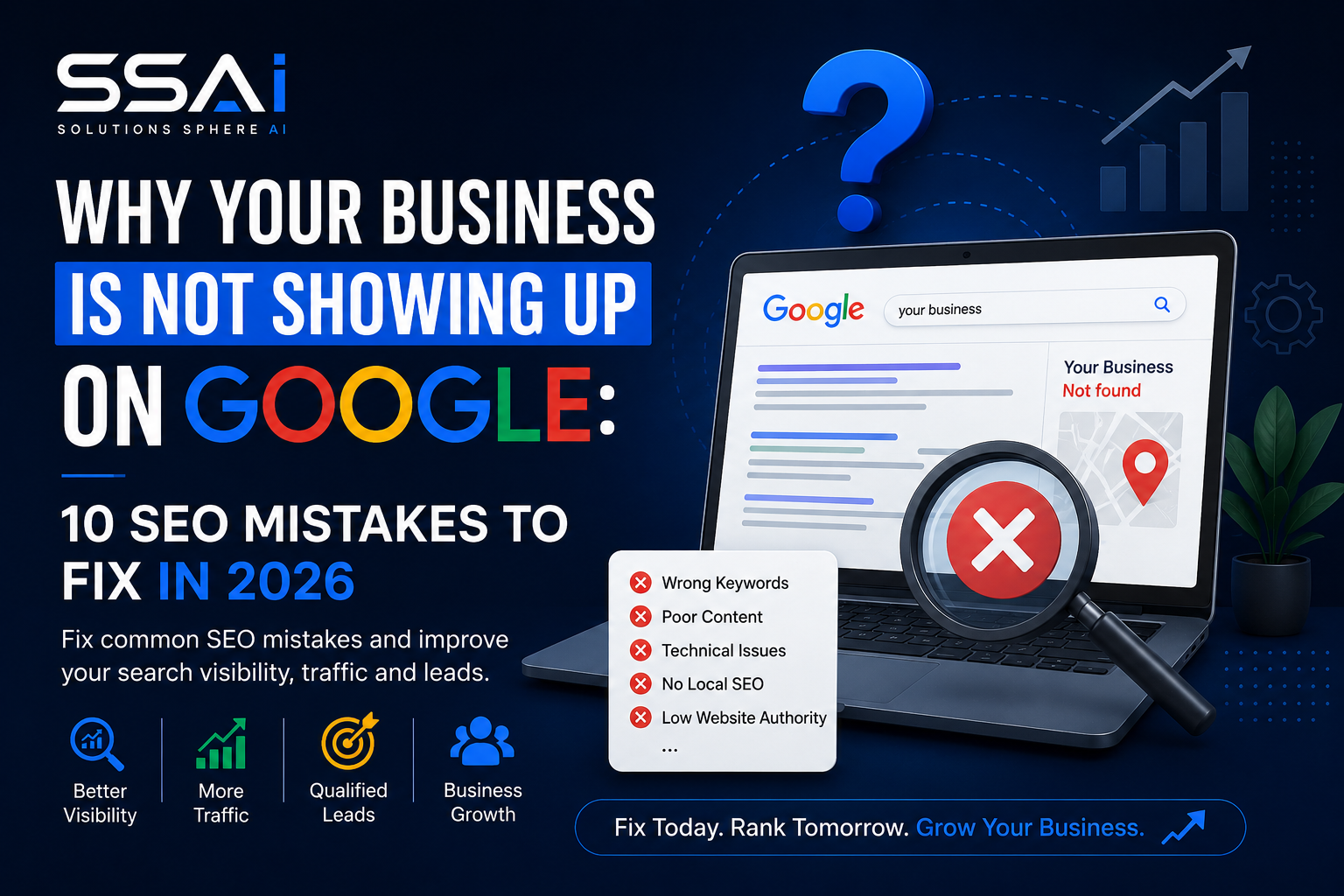
If your business website is not appearing on Google when potential customers search for your products or services, you are not alone. Many businesses invest in a website, publish a few pages, and expect search engines to automatically bring customers to them. In reality, achieving visibility on Google requires a combination of technical SEO, useful content, search intent, website authority, local optimization, and consistent effort.
Search behaviour is also changing in 2026. Customers are discovering businesses through traditional search engines, Google Maps, social platforms, and increasingly AI-powered search experiences. This makes it more important than ever for businesses to build a strong and consistent digital presence.
If your website is struggling to appear in search results, the problem may not be one single issue. It could be a combination of several SEO mistakes. Here are ten common problems businesses should identify and fix.
1. Your Business Does Not Have a Clear SEO Strategy
One of the most common reasons a business struggles with Google visibility is the absence of a clear SEO strategy. Simply having a website does not mean that search engines understand what your business does, which customers you serve, or which searches your website should appear for.
An effective SEO strategy starts by identifying your target audience, understanding what they search for, researching relevant keywords, and mapping those search terms to the right pages on your website. Your homepage, service pages, location pages, and educational content should each have a clear purpose.
Without this structure, businesses often create random pages and blog posts that target unrelated keywords. This makes it difficult to build topical relevance and establish meaningful search visibility.
2. You Are Targeting the Wrong Keywords
Choosing keywords based only on search volume can be a major SEO mistake. A keyword may have thousands of monthly searches but still generate very little business if the people searching for it are not looking for what you offer.
For example, a digital marketing company may target the broad keyword "digital marketing." While the keyword may have significant search demand, it is extremely broad and competitive. A more specific search such as "digital marketing agency in Bangalore" or "SEO services for manufacturing companies" may have a stronger commercial intent.
Good keyword research considers search volume, competition, relevance, search intent, and the likelihood that the search can lead to a meaningful business action.
3. Your Content Does Not Match Search Intent
Getting a keyword onto a webpage is not enough. Your content needs to answer the question behind the search.
Someone searching for "what is SEO" is probably looking for educational information, while someone searching for "SEO services in Bangalore" may be comparing agencies and preparing to contact a service provider. These users have different intentions and should not necessarily be sent to the same type of page.
If your content does not satisfy the user's intent, it can struggle to perform well even when the page contains relevant keywords. Businesses should therefore create content based on what users actually want to accomplish when they search.
4. Your Website Has Technical SEO Problems
A website can have excellent content and still struggle with search visibility if its technical foundation is weak. Search engines need to be able to crawl, understand, and index your website efficiently.
Technical SEO can involve several areas, including website speed, mobile usability, crawlability, indexation, internal links, XML sitemaps, canonical URLs, redirects, structured data, and overall site architecture.
Businesses should regularly check whether important pages are being indexed and whether technical problems are preventing search engines from accessing or understanding their content. A technically healthy website gives your content a stronger foundation for organic search performance.
5. Your Pages Have Weak Titles and Meta Descriptions
Page titles and meta descriptions are often overlooked, especially by businesses that focus primarily on design. However, they provide important context about a webpage and can influence how users interact with your listing in search results.
A good page title should clearly communicate what the page is about and naturally include the primary topic or keyword where appropriate. The meta description should provide a concise and compelling explanation of what the visitor can expect from the page.
For example, instead of using a generic title such as "Services," a digital marketing company could use a more descriptive title such as "Digital Marketing Services for Business Growth | SSAI." The goal is to make the page topic immediately understandable to both search engines and potential visitors.
6. You Are Ignoring Local SEO
If your business serves customers in a specific city or region, local SEO can have a significant impact on visibility. Many customers use location-based searches when looking for nearby companies, agencies, professionals, products, and services.
Businesses targeting local customers should maintain accurate information across their online profiles, optimize their Google Business Profile, build relevant location-focused content, encourage genuine customer reviews, and ensure that business information is consistent across important platforms.
For example, a business serving Bengaluru may benefit from creating useful content around its services and the local market rather than trying to rank only for broad national keywords. Local SEO helps businesses connect their online presence with customers who are actively searching within their service area.
7. Your Website Does Not Have Enough Useful Content
A website with only a homepage and a few basic service pages may not provide enough information to establish strong topical relevance. This does not mean businesses should publish hundreds of low-quality articles. It means they should create useful content around the questions, challenges, and topics that matter to their target customers.
For a digital marketing company, relevant content could include SEO guides, digital marketing strategies, AI search visibility, content marketing advice, social media marketing insights, and industry-specific marketing resources.
Over time, this creates a content ecosystem that helps search engines understand the subjects your business has expertise in while giving potential customers more opportunities to discover your website.
8. Your Content Is Not Built for Modern Search and AI Discovery
Search is becoming broader than traditional Google results. Customers can discover information through AI-powered platforms, conversational search, social networks, maps, video platforms, and other digital channels.
This does not mean businesses need a completely separate strategy for every platform. Instead, they need to build a strong digital information foundation. Your website should clearly explain who you are, what you offer, who you serve, and why your business is relevant.
Detailed service pages, useful educational content, clear business information, consistent terminology, structured content, and genuine expertise can all contribute to stronger digital discoverability.
Businesses should think beyond the question "How do I rank number one on Google?" and start asking a broader question: "How can my business become visible when potential customers search for the problems we solve?"
9. Your Website Lacks Internal Links
Internal linking is one of the simplest SEO opportunities that many businesses overlook. Internal links connect relevant pages on your website and help both users and search engines discover related information.
For example, a blog article about SEO mistakes could link to your SEO services page. An article about content marketing could link to your Content Marketing service. A guide about social media strategy could link to your Social Media Marketing service.
This creates relationships between your content and important commercial pages. It also helps visitors move naturally from educational information toward relevant services or solutions.
A well-structured internal linking strategy can therefore improve website navigation, distribute authority across relevant pages, and create a stronger overall site structure.
10. You Are Measuring Traffic Instead of Business Results
Another common SEO mistake is focusing entirely on website traffic and rankings without considering whether that traffic contributes to business growth.
Ranking for a keyword can be valuable, but the real objective of most commercial websites is to generate meaningful business outcomes. Depending on the business, these may include qualified inquiries, consultation requests, phone calls, form submissions, purchases, or other conversions.
Businesses should therefore monitor metrics such as organic traffic, qualified leads, conversion rates, landing-page performance, and revenue generated from organic search where measurement is possible.
SEO should not be treated simply as a traffic-generation exercise. It should be connected to broader business objectives.
How Long Does SEO Take to Show Results?
SEO is a long-term digital marketing strategy rather than an instant advertising channel. The time required to see meaningful results can vary considerably depending on the competitiveness of the industry, the condition of the website, the quality of the content, the strength of the domain, the target keywords, and the consistency of the SEO strategy.
New websites and businesses competing in highly competitive markets may need more time to establish authority. Businesses with an established website and strong content foundation may be able to see improvements sooner.
The important thing is to evaluate SEO based on progress over time rather than expecting immediate results from a few weeks of activity.
What Should You Do If Your Business Is Not Ranking on Google?
If your website is not appearing for relevant searches, start with an SEO audit. Review whether your important pages are indexed, whether your website has technical issues, whether your page titles and content are optimized, whether you are targeting the right keywords, and whether your content matches search intent.
Next, evaluate your content and website structure. Identify important topics that your customers search for and build useful pages and resources around them. Strengthen internal linking and make sure your commercial pages clearly communicate the services or products you provide.
For businesses serving specific locations, review your local SEO presence and make sure your business information is accurate and consistent.
Finally, establish a process for measuring organic performance. SEO requires continuous improvement, so regularly reviewing search performance, user behaviour, rankings, conversions, and content performance can help identify new opportunities.
Build Search Visibility That Supports Business Growth
Being visible on Google is no longer just about adding keywords to a website. Modern search visibility requires a combination of technical SEO, useful content, search intent, local optimization, website quality, authority, and a clear understanding of your target audience.
As search continues to evolve with AI-powered discovery and changing customer behaviour, businesses need to think about digital visibility more broadly. A strong SEO foundation can help your business become easier to discover, while valuable content and a well-structured website can turn that visibility into meaningful customer engagement.
At Solutions Sphere AI Pvt Ltd (SSAI), our digital marketing approach focuses on helping businesses strengthen their online visibility through AI & Search Visibility, SEO, Content Marketing, and Social Media Marketing. We combine strategic planning with practical execution to help businesses build a stronger digital presence and create sustainable opportunities for growth.
If your website is not generating the visibility or enquiries you expect, the first step is understanding what is holding it back.
Explore SSAI's Digital Marketing Services or Contact SSAI to discuss your digital growth goals.