

Introduction
Choosing the right keywords and setting a budget are just two of the ingredients for running successful Google Ads campaigns. A big question for B2B marketers is Smart Bidding vs Manual Bidding. Both methods assist businesses in managing advertising spend, but they differ in how they optimize campaigns.
This decision is particularly relevant in B2B marketing as purchase journeys are typically longer and involve multiple decision makers. Just because a campaign is generating hundreds of clicks doesn’t mean it’s generating qualified inquiries or real business opportunities. By understanding how each bidding strategy works, businesses can make better advertising decisions, improve the quality of their leads and get the most out of their marketing budgets.
What Is Manual Bidding in Google Ads?
Manual Bidding puts the power in the hands of advertisers to set their own price for individual clicks. Manual CPC gives marketers the ability to set max bids on individual keywords and ad groups.
This is useful for B2B businesses targeting niche industries or high value search terms. For instance, a company selling enterprise software may choose to bid more aggressively on searches like "enterprise software solutions," but limit budget on broader terms that bring in less targeted visitors.
Another benefit is more control over advertising spending. Marketers can adjust bids depending on keyword performance, competition and quality of incoming traffic.
Manual Bidding however requires constant monitoring and optimization. Advertisers must monitor search terms and click costs along with the performance of the campaign. Managing multiple campaigns manually can be a time-consuming process, especially in competitive B2B markets.
Smart Bidding: What It Is and How It Works
Smart Bidding uses Google's machine learning to automatically adjust your bids in real time, across all eligible auctions, to help you maximize conversions or conversion value. The system uses contextual signals such as device, location, time, and other auction-time information to estimate the probability of conversion.
There are a number of Smart Bidding strategies available on Google Ads including: Maximize Conversions, Target CPA, Maximize Conversion Value and Target ROAS.
A B2B technology company running lead-generation campaigns, for example, could use Maximize Conversions to increase inquiries within its advertising spend. If it has reliable conversion-value data, it could use Maximize Conversion Value to target the opportunities with the most potential business value.
The biggest benefit is automation. Instead of making manual bid adjustments throughout the day, marketers can let Google’s algorithms optimize bids based on the available performance data.
But Smart Bidding is highly dependent on accurate conversion tracking. If every submission from a business is considered an equal value conversion, the algorithm could favor inquiry volume over truly qualified leads.
Smart Bidding vs Manual Bidding: Which is Best for B2B?
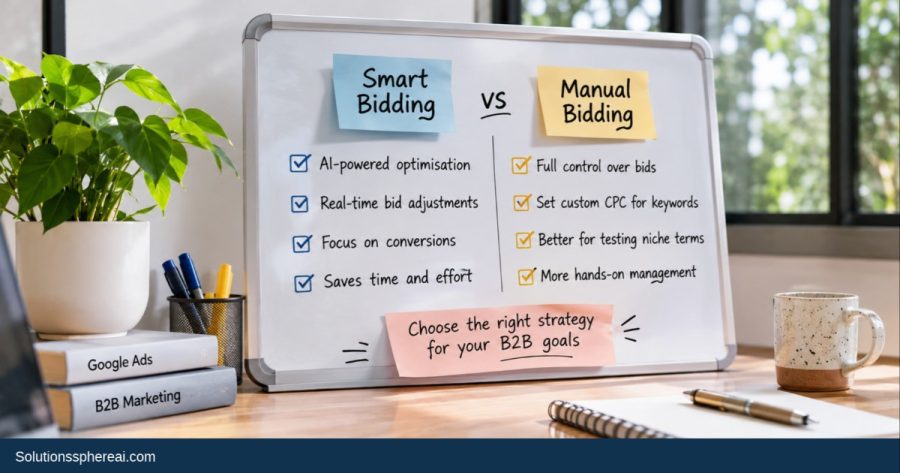
The difference between the two comes down to control and automation. Smart Bidding uses machine learning to optimize bids based on conversion objectives whereas Manual Bidding allows marketers to have control over individual keyword investments.
Manual Bidding is generally useful for businesses launching new campaigns, testing niche keywords or if working with limited conversion data. This gives you an opportunity to get to know search behavior and to find out which keywords bring in the right kind of audience.
Smart Bidding works best for existing campaigns that have good conversion tracking and enough performance data. It helps businesses run bigger campaigns and optimize them for specific lead generation goals.
No single strategy is guarantyd to work best. At the end of the day, what drives campaign performance is conversion data quality and landing page experience, as well as audience targeting and keyword relevance.
B2B Campaigns: Why Conversion Tracking Matters
Another common mistake businesses make when they adopt Smart Bidding is using incomplete conversion data.
Imagine a B2B marketing agency getting 50 leads from Google Ads. That campaign may look like a success, but it could be that only five leads are coming from businesses that match the ideal customer profile.
If all 50 inquiries are treated as equal, Google’s algorithm may optimize to generate more submissions, not better prospects.
To prevent this, businesses need to track meaningful conversion actions, connect their CRM systems with Google Ads where possible, and track qualified leads and sales opportunities.
It shouldn’t be just about reducing cost per lead. It should be to attract prospects who are truly likely to become paying customers.
Can B2B Companies Use Both Bidding Strategies?
Yes. Businesses do not need to apply the same bidding strategy for each campaign.
For example, a newly launched campaign targeting specialized industrial keywords may initially use Manual CPC to get a feel for keyword performance and control spend. Meanwhile, a mature campaign with a steady flow of leads might utilize Target CPA or Maximize Conversions.
Structured campaign testing can also enable marketers to test different bidding approaches. However, they should allow enough time to collect conversion data before evaluating performance.
Campaigns are hard to understand when bidding targets, budgets and conversion settings change often, making it difficult to tell what is actually improving campaign results.
Choosing the Right Bidding Strategy
The right strategy depends on the campaign objectives, the data available and the business requirements.
Businesses with limited campaign history, niche keywords or strict budget requirements can look at Manual CPC. It gives marketers more control as they understand their target audience and the performance of the advertisements.
Smart Bidding helps businesses with established campaigns, reliable conversion tracking and consistent lead-generation activity.
For B2B companies with longer sales cycles, it’s especially important to track qualified leads and actual sales outcomes. Sometimes a campaign that produces fewer, but higher-quality leads is much more valuable than one that produces high volumes of irrelevant leads.Businesses looking to improve their advertising performance may also benefit from working with experienced marketing specialists who understand campaign optimisation, audience targeting and budget management. Exploring performance marketing companies in india can help businesses understand different approaches to paid advertising, while comparing performance marketing agencies in india can help identify the right expertise for managing campaigns and improving lead generation.
Conclusion
B2B advertising can benefit from both Smart Bidding and Manual Bidding. Manual Bidding gives you control and flexibility, while Smart Bidding gives you automation and machine-learning-based optimization.
The best way forward is not necessarily to choose one or the other, but to understand where each strategy works to support business objectives. With the right bidding strategy, accurate conversion tracking, relevant keywords, compelling ads, and optimized landing pages, businesses can improve the efficiency of their campaigns and generate meaningful sales opportunities.
At SSAI, we help businesses build data-driven marketing strategies that link advertising performance to measurable business outcomes. We are a B2B Digital Marketing Agency Bengaluru that is dedicated to helping you increase your online visibility, connect with the right audience, and generate business leads through strategic digital marketing.
A Google Ads management agency that actively tests Smart Bidding against manual strategies, rather than defaulting to one approach, is better placed to find the setup that actually lowers cost per qualified lead.