

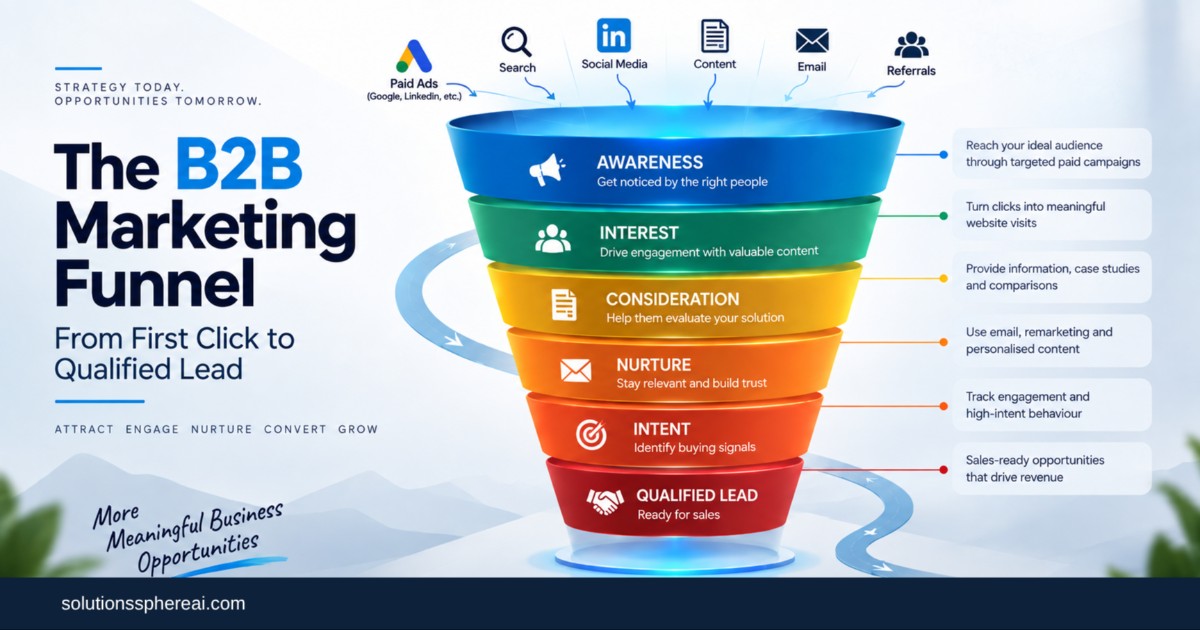
The real challenge is what happens after that first interaction. B2B purchases usually take time. People research different options, compare companies, discuss decisions internally, and often need approval before spending money. A prospect might discover your company today and not contact you until several months later.
That's what the B2B marketing funnel helps you understand: how someone moves from knowing your company exists to becoming a genuine sales opportunity.
The Funnel Starts Before the Lead
Most companies think about leads too early. They see someone visit the website and immediately want them to fill out a form or book a meeting. But put yourself in the buyer's position. If you've never heard of a company before, would you really hand over your contact details after reading one blog?
Probably not. Most buyers need a little time. The first step is simply getting their attention. They might find you through Google, LinkedIn, an industry publication, a referral, or a piece of content someone shared with them. And interestingly, they often aren't searching for your product.
They're searching for a problem. A marketing manager might search for ways to improve lead generation. A business owner might search for ways to reduce costs. An operations manager might be looking for ways to improve productivity. They may not know which company they need yet. They're just looking for answers. That gives B2B companies an opportunity to become part of the conversation early.
Getting the Right People to Your Website
This is where SEO and content marketing come in. A well-written blog can introduce your company to someone who has never heard of you. A useful LinkedIn post can make them curious enough to visit your website. A research report can give them a reason to remember your brand.
But there's something more important than traffic: relevance. Getting 20,000 visitors sounds impressive. But if none of them are potential customers, those numbers don't mean much. For B2B companies, 2,000 relevant visitors can be more valuable than 20,000 random ones. That's why your content should speak directly to the problems, questions, and interests of the people you actually want to reach.
What Happens After the First Visit?
Let's say someone reads one of your blogs. What happens next? If the only option on the page is "Contact Us," there's a good chance they'll leave. They aren't necessarily ready to talk to sales yet. Instead, give them another useful reason to stay connected.
Maybe the blog links to a detailed guide. The guide leads to a case study. The case study introduces a particular solution. Eventually, the prospect might decide they're ready to speak with someone. It could look like this:
Blog → Guide → Case Study → Solution → Conversation
There's no pressure to buy at every step. You're simply giving the person useful information as their interest develops. This is especially important in B2B because buyers often want to educate themselves before they speak to a salesperson.
Now consider another person. They visit your website several times. They look at your services. They check pricing. They read a case study. They attend a webinar. A few days later, they request a consultation. That's a very different situation. The difference is intent.
Knowing When a Lead Is Worth Passing to Sales
This is where lead qualification comes in. Not every person who gives you their email address is a good sales opportunity. And that's okay. A qualified lead should generally have some combination of the right company profile, a genuine business problem, the ability to influence a purchase, a realistic budget, and a reason to act within a reasonable timeframe. Good qualification helps sales teams spend their time on conversations that have a real chance of going somewhere.
The Marketing-Sales Gap
There's a reason you often hear sales teams complain about marketing leads. Marketing might say, "We generated 300 leads this month." Sales might respond, "Yes, but only 10 of them were actually worth calling." The problem isn't necessarily that marketing failed. The two teams may simply be measuring different things. Marketing may be focused on traffic, downloads, and lead volume, while sales cares about conversations, opportunities, and revenue.
This is why businesses need a shared understanding of what a good lead looks like. Marketing Qualified Leads, or MQLs, and Sales Qualified Leads, or SQLs, can help create that common language. More importantly, sales needs to tell marketing which leads are actually converting. That feedback can improve everything from content and targeting to lead scoring and campaign strategy.
Content Shouldn't Just Fill a Calendar
There's a lot of pressure on B2B companies to "post consistently." But publishing something every Tuesday doesn't automatically create a good content strategy. Every piece of content should have a reason for existing. An introductory blog might help someone understand a problem. A deeper guide can help them explore it further. A case study can show how another company solved a similar challenge. A comparison article can help them evaluate their options. A product page can answer the questions that come up just before a buying decision.
The important question isn't simply:
"What should we publish this week?"
It's:
"What question is our buyer likely to ask next?"
That approach makes content feel much more useful—and much less like advertising.
Where AI Comes Into the Picture
AI is making parts of the B2B funnel easier to manage. It can help analyse customer behavior, identify patterns, personalise content, automate parts of lead nurturing, and highlight prospects who appear to be showing stronger buying signals. Imagine having hundreds of people interact with your content. Instead of manually trying to understand every interaction, AI can help identify patterns—such as which prospects keep returning to your website, which pages they visit, and which content they engage with.
That information can help marketers and sales teams decide where to focus their attention. But AI isn't a magic solution. If you're targeting the wrong audience or producing content that nobody finds useful, AI won't fix that. It will simply help you do it faster. The fundamentals still matter.
Don't Let Traffic Be the Only Success Metric
Website traffic is useful. It's just not the whole story. If 10,000 people visit your website and only a handful are relevant to your business, you haven't necessarily had a successful month. A better picture comes from looking at what happens after those visits. How many people engage with your content? How many become leads? How many are qualified? How many turn into sales opportunities? And eventually, how much revenue comes from those efforts?
Sometimes, 1,000 highly relevant visitors who generate 20 strong sales conversations are much more valuable than 10,000 visitors who never take another step. That's why B2B marketing should ultimately be measured by business impact, not just activity.
The First Click Is Only the Beginning
A B2B buyer rarely moves in a straight line. They search. They read. They compare. They leave. They come back. They talk to someone internally. They research again. Your marketing needs to account for that.
The best funnels don't try to push people into a sales conversation before they're ready. They give prospects useful information, earn their trust, and make the next step easy when the timing is right. Because getting someone to click is only the beginning.
The real challenge—and the real opportunity—is turning that first click into a relationship, and eventually, into a qualified business opportunity. Paid advertising can be one of the quickest ways for a B2B company to get in front of the right audience.
How Solutions Sphere AI Fits Into the B2B Funnel
At Solutions Sphere AI (SSAI), the idea is to bring different parts of B2B marketing together instead of treating them as separate activities. SEO can bring the right audience in, content can answer their questions, and AI-driven insights can help businesses understand which interactions actually matter.
This helps SSAI better target and perform conversion strategies that can help turn interest into real opportunities. At SSAI The focus isn't simply on getting more visitors or collecting more forms. It's about helping businesses understand the journey between the first click and the qualified lead and improving that journey along the way