

What Does Website Architecture Mean for a B2B Website?
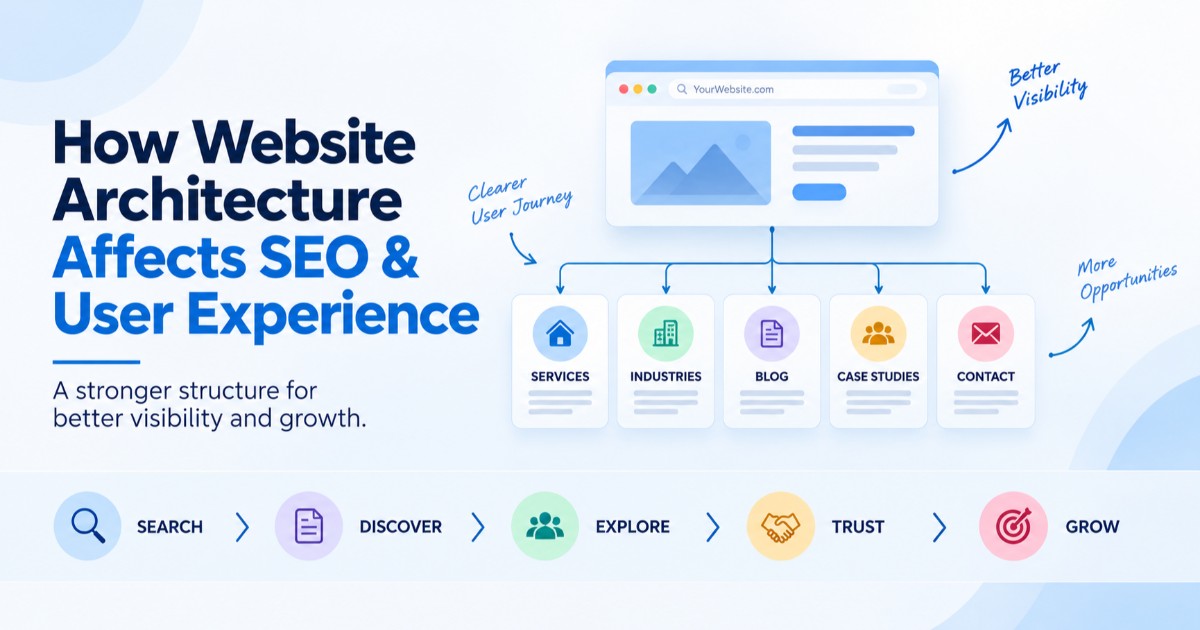
Website architecture is essentially the way all the pages on a website are organised and connected. It determines how someone moves from the homepage to a service page, from a service page to a case study, or from an educational blog to a relevant solution.
For a B2B company, a simple structure might look like Homepage, Services, Industries, Resources, Case Studies, About and Contact. From there, each section can become more specific. A digital marketing company, for example, might have a Services section that includes SEO, performance marketing, and content marketing. It might also have an Industries section with dedicated pages for technology, healthcare, manufacturing, or professional services.
The trick is that the structure should mirror how customers really search for information. A potential client should not have to search through several unrelated pages to understand what a company does or determine whether its services are relevant to their business.
The Importance of Website Architecture for B2B SEO
Search engines need to crawl websites, understand their content and know how the different pages relate to each other. A clear architecture makes this process easier.
This becomes particularly important for B2B websites because they often contain a large amount of information. A company may have separate pages for multiple services, industries, products, locations, case studies, resources and hundreds of blog articles. As the website grows, simply adding more content is not enough. That content needs to be organised properly.
Imagine a B2B technology company that offers several digital solutions. It publishes articles about SEO, lead generation, Google Ads, LinkedIn marketing and content strategy. By publishing these articles on their own, without linking them back to relevant service pages, the website can start to feel like a bunch of random articles.
A more effective way is to make relevant links in the content. A B2B lead generation article can easily guide readers to a related lead generation service. A guide about technical SEO can connect to the company's SEO services. A case study can then provide evidence of how the company has applied those services for a client.
This creates a much clearer relationship between content and commercial pages, which is useful for both visitors and search engines.
Internal Linking Can Connect the B2B Buying Journey
Internal linking is one of the simplest but most important parts of website architecture. It allows one page on a website to guide visitors towards another relevant page.
Internal links can do more than just help users navigate for B2B companies. They can support the entire research journey.
Someone might discover a company through a Google search for a specific problem. They read an article, find a link to a related service, explore a case study and eventually reach a contact page. The visitor has moved from learning about a problem to understanding a solution and then evaluating the company.
This journey does not need to feel forced. In fact, the best internal links are usually the ones that feel natural. When an article genuinely answers one question but a related service page can provide a deeper solution, linking the two makes sense for the reader.
It also gives search engines additional context about the relationship between different areas of the website.
Website Architecture Can Influence User Experience
B2B buyers are usually looking for information, not entertainment. They want to understand whether a company can solve a particular problem and whether it is worth starting a conversation.
If that information is difficult to find, frustration can build quickly.
Consider a visitor who lands on a B2B company's website after searching for a specific service. They understand the service, but they now want to know whether the company has experience in their industry. If there is no clear route from the service page to relevant industry information or case studies, the visitor has to start searching manually.
That may sound like a small inconvenience, but every additional barrier can make the experience less efficient.
Good website architecture removes much of this friction. Services should integrate seamlessly with related industries, case studies should be easy to locate and educational content should point users toward deeper information where relevant.
The goal is not to make every page one click away from the homepage. It is to make the journey logical.
Architecture Also Affects B2B Content Strategy
Many B2B companies invest heavily in blogs but do not always think about how those blogs fit into the larger website.
Publishing an article every week can generate a lot of content, but if those articles are not connected around meaningful topics, their value can be limited.
A stronger approach is to build content around areas that matter to the company's customers and services.
For example, a company providing technical SEO services could create a broader technical SEO resource and support it with articles about website architecture, crawlability, indexation, internal linking, structured data and site performance.
Each article can then connect to other relevant resources and, where appropriate, to the company's service page.
Over time, this creates a more organised content ecosystem. Visitors can move from a general question to a more specific topic and eventually discover the company's solution.
B2B Websites Need Clear Commercial Paths
One of the biggest mistakes businesses make is treating SEO traffic as the final goal.
Getting visitors to a website is important, but for most B2B companies, the ultimate objective is to generate meaningful business opportunities.
That means the website should make it easy for interested visitors to take the next step.
A visitor might first arrive through an informational blog. They may then read a service page, explore a case study and decide they want to speak to the company. The website architecture should support that progression.
Calls to action, service pages, enquiry forms and contact information should therefore be connected naturally to the rest of the website rather than existing as isolated elements.
This is where SEO and user experience come together. A page that ranks well but provides no clear next step may generate traffic without generating enough business value.
Common Architecture Problems on B2B Websites
As a B2B website grows, its structure can easily become complicated. New services get added, new industries are targeted, blog categories multiply and landing pages are created for different campaigns.
Eventually, some pages may become difficult to reach. Others may have no meaningful internal links pointing towards them. Similar pages may start competing for the same search terms, while important service pages may receive very little internal linking.
Navigation can also become overcrowded, making it harder for visitors to understand where they should go.
These problems are not always obvious when looking at a website from the homepage. A proper technical and structural review is often required to understand how search engines and users are actually moving through the site.
Building a Better Architecture for B2B Growth
A good B2B website structure should begin with the business itself. Before changing menus or URLs, companies should understand their most important services, target industries, customer needs and conversion points.
And the website can be built around those priorities from there. Related services can be grouped together, industry pages can connect with relevant solutions, case studies can support commercial pages, and educational content can guide visitors towards deeper resources.
Internal links should be added with the user in mind rather than simply for SEO. Every link should ideally help answer the question, "What would this visitor want to explore next?"
For companies looking for Technical SEO Services Bengaluru, this broader approach is important. Technical SEO should not simply mean fixing broken links or checking whether pages are indexed. Website architecture, crawlability, internal linking, content structure and user experience all contribute to how effectively a B2B website performs.
A professional Technical SEO Services company can help businesses identify these structural issues and create a website that is easier for search engines to crawl and easier for potential customers to navigate.
Final Thoughts
At SolutionsSphereAI (SSAI) we view SEO in this greater B2B context. All these things are meant to work together, not in isolation, the technical foundation, the architecture of the website, the content strategy, the experience for users, and the lead generation. A well-structured website gives search engines a clearer understanding of the business while giving potential customers a simpler path from discovery to decision.
Website architecture may not be the most visible part of a B2B website, but it influences almost everything happening beneath the surface. It affects how search engines discover content, how visitors move between pages, how easily prospects find evidence of expertise and how naturally they progress towards an enquiry.
For B2B businesses SSAI believes the best website structure is not necessarily the one with the most pages or the most complicated navigation. It is the one that makes sense from the customer's perspective.
When services, industries, content, case studies, and conversion points are logically connected, the website becomes more than a collection of pages. It becomes a guided digital experience that helps potential customers understand the business, explore its expertise and take the next step when they are ready.