

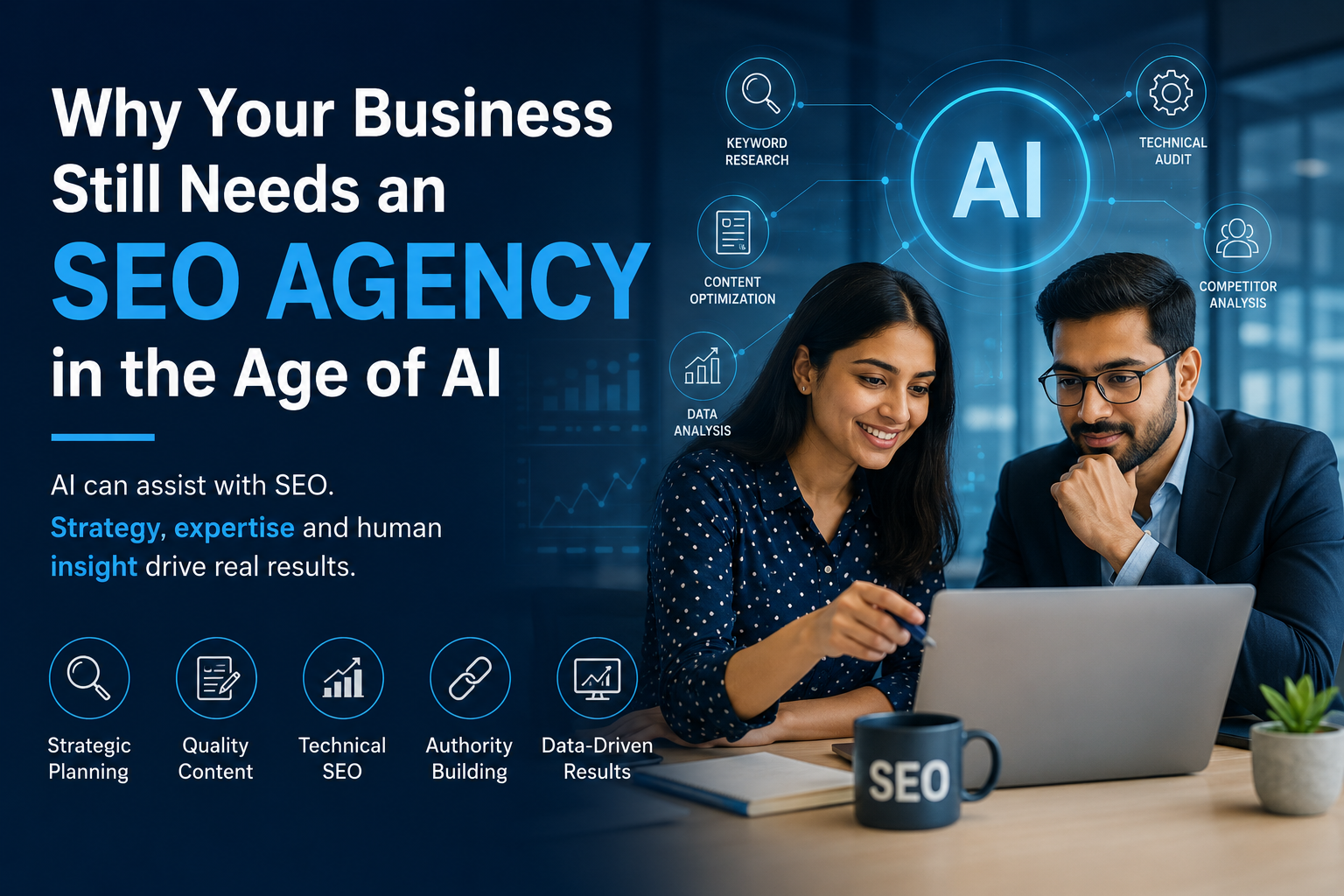
Artificial intelligence is changing the way businesses approach digital marketing and search engine optimization. AI tools can now assist with keyword research, content planning, competitor analysis, data interpretation, technical audits, and many other SEO activities. As these technologies become more accessible, businesses are naturally asking an important question: if AI can perform so many SEO tasks, does a business still need an SEO agency?
The answer is yes. AI is changing SEO, but it is not replacing the need for SEO expertise. In fact, as search becomes more complex, businesses need a stronger combination of technology, strategy, industry knowledge, and human judgment. The future of SEO is not about choosing between AI and SEO professionals. It is about using AI to make experienced SEO teams more efficient, informed, and effective.
AI Has Changed SEO, But It Has Not Replaced It
SEO has never been limited to adding keywords to webpages. Effective search engine optimization requires an understanding of a company's business model, customers, competitors, products, services, industry, and growth objectives. AI can process large amounts of information quickly, but it does not automatically understand which opportunities are most important for a particular business.
For example, an AI tool can identify hundreds of keywords related to a company's products or services. However, deciding which keywords should be prioritized requires strategic thinking. Some keywords may have high search volume but very little relevance to the business, while other highly specific keywords may have lower search volume but attract customers with stronger intent.
An experienced SEO agency brings the knowledge required to evaluate these opportunities and build a strategy around the business rather than simply following recommendations generated by a tool.
What AI Can Do for SEO
AI has become a powerful tool within modern SEO workflows. It can assist with keyword research, search intent analysis, competitor research, topic clustering, content planning, content briefs, internal linking recommendations, data analysis, reporting, and content optimization.
These capabilities allow SEO professionals to spend less time on repetitive tasks and more time on strategy, analysis, creativity, and decision-making. AI can process information at a scale that would take considerably longer to handle manually, allowing an SEO team to identify patterns and opportunities more efficiently.
However, the important distinction is that AI should support the SEO process rather than become the SEO strategy itself. Technology can help identify information and possibilities, but experienced professionals still need to determine what those insights mean for a specific business and how they should be implemented.
AI Can Produce Content, But Strategy Determines What Should Be Created
Generative AI has made content production significantly faster. Businesses can now create article outlines, content ideas, product descriptions, FAQs, social media concepts, and other marketing materials within minutes. However, producing content quickly does not automatically make that content useful or valuable.
If every business uses AI to generate similar articles around the same keywords, publishing more content alone will not create a meaningful competitive advantage. Businesses need content that demonstrates expertise, answers genuine customer questions, provides useful information, and offers something valuable beyond what is already available online.
This is where an SEO agency can add significant value. AI can support research and content development, while SEO professionals and content strategists determine which topics are worth pursuing, who the content should be written for, what search intent needs to be addressed, and how the content connects to the overall business strategy.
The question is no longer simply how much content a business can produce. The more important question is whether the content deserves to be found.
SEO Requires an Understanding of the Business
Every business has a different audience, customer journey, competitive environment, and set of priorities. A manufacturing company, technology provider, professional services firm, and B2B supplier may all invest in SEO, but their search behaviour, competition, terminology, and content requirements can be completely different.
An effective SEO agency begins by understanding the business before developing the SEO strategy. This includes understanding the company's products and services, target audience, market positioning, competitors, customer questions, sales cycle, and business objectives.
This context helps an agency identify search opportunities that are genuinely relevant to the business. Instead of simply trying to increase website traffic, the focus becomes attracting the right audience and building visibility around topics that matter to potential customers.
B2B SEO Requires More Than Traffic
For B2B businesses, SEO becomes even more strategic because the objective is not always to generate the largest possible amount of website traffic.
B2B purchasing decisions can involve multiple stakeholders, longer consideration periods, technical products or services, and highly specific search queries. A keyword may receive relatively low search volume but still be extremely valuable if it attracts the right decision-makers.
For example, a B2B company may receive more business value from ranking for a specific industry-related search than from ranking for a broad keyword with thousands of monthly searches.
This is why B2B SEO needs to consider search intent, relevance, customer journey, industry terminology, content depth, and lead quality rather than focusing only on rankings and traffic.
An experienced SEO agency can connect these factors to the broader objectives of the business.
Technical SEO Still Requires Expertise
AI can help identify potential technical SEO problems, but identifying an issue is only one part of solving it. Technical SEO can involve website architecture, crawling, indexing, internal linking, redirects, canonicalization, structured data, mobile usability, page performance, and other technical factors.
Different websites can also require different solutions depending on their technology, structure, content management system, and business requirements. A technical SEO report may identify dozens of possible issues, but not every issue has the same level of importance.
An experienced SEO team can prioritize technical improvements based on their potential impact and coordinate with developers or website teams to implement the appropriate changes.
The value is not simply finding problems. It is knowing which problems matter most and what should be done about them.
Search Is Becoming More Complex
The search landscape is evolving beyond traditional search engine results. Customers can discover information through search engines, AI assistants, maps, social media platforms, video platforms, industry directories, marketplaces, review websites, and online communities.
This means businesses need to think about search visibility more broadly.
Traditional SEO remains important, but businesses also need strong content, clear brand information, authoritative resources, and a consistent digital presence across relevant platforms.
An experienced SEO agency can help businesses adapt to these changes instead of relying exclusively on traditional keyword-ranking strategies.
AI Makes Good SEO Agencies More Powerful
The strongest argument for working with an SEO agency in the age of AI is not that agencies can do things that AI cannot. The advantage is that experienced SEO professionals can use AI to perform their work more efficiently and intelligently.
AI can accelerate research, while an SEO strategist determines what matters. AI can identify patterns, while a specialist interprets those patterns in the context of the business. AI can generate content ideas, while a content strategist decides which ideas deserve investment. AI can analyze large datasets, while an SEO team turns those insights into an actionable strategy.
This combination creates a stronger process than relying exclusively on either technology or manual work.
The future of SEO is therefore not necessarily AI versus SEO agencies. It is AI-enabled SEO agencies delivering more intelligent, efficient, and strategic search marketing.
What a Modern SEO Agency Should Offer
Businesses should expect more from an SEO agency than keyword reports and monthly ranking screenshots. A modern SEO agency should begin with business objectives and translate those objectives into a search strategy.
The agency should understand the target audience, identify relevant search opportunities, evaluate the competitive landscape, improve technical website performance, develop useful content, strengthen search visibility, monitor changes in search behaviour, and continuously optimize the strategy.
AI should be used wherever it can improve efficiency and insight, but it should not replace strategic thinking or human accountability.
Transparency is equally important. Businesses should understand what is being worked on, why specific activities are being prioritized, what the results mean, and what should happen next.
How to Choose an SEO Agency in the Age of AI
Choosing an SEO agency in 2026 requires looking beyond claims about rankings, automation, or artificial intelligence. Businesses should evaluate whether the agency understands their industry, target audience, business model, and objectives.
It is also important to understand how the agency uses AI within its SEO process. AI should support research, analysis, content development, and optimization rather than being used simply to generate large quantities of generic content.
Businesses should also ask how the agency measures success. Rankings and traffic can be useful indicators, but qualified leads, conversions, engagement, and meaningful business outcomes provide a more complete picture of SEO performance.
A good SEO agency should be able to explain its strategy clearly. If an agency cannot explain why it is targeting particular keywords, creating specific content, or prioritizing certain technical improvements, it may be relying too heavily on tools rather than strategic expertise.
The Future Is AI-Powered, Human-Led SEO
AI will continue to change SEO. It will make research faster, analysis more sophisticated, content workflows more efficient, and marketing teams more productive.
However, SEO will continue to require human understanding. Businesses still need professionals who understand customers, markets, brands, competition, positioning, content quality, and business objectives. They need specialists who can interpret data, make decisions, test strategies, and take responsibility for the direction of their SEO program.
The future is therefore not about replacing SEO professionals with AI. It is about giving SEO professionals better tools.
Businesses that combine the right technology with the right expertise will be better positioned to adapt as search continues to evolve.
Why SSAI Takes an AI-Driven Approach to SEO
At Solutions Sphere AI Pvt Ltd (SSAI), we believe artificial intelligence should strengthen digital marketing expertise rather than replace it.
Our approach combines SEO strategy with AI-assisted research, analysis, content planning, and optimization. This allows businesses to benefit from the efficiency of modern technology while retaining the strategic thinking, human judgment, and business understanding required for effective SEO.
SSAI's digital marketing services focus on four key areas: AI & Search Visibility, SEO, Content Marketing, and Social Media Marketing. By bringing these capabilities together, we help businesses build a more connected and sustainable digital presence.
For B2B businesses, our focus is not simply on generating more website traffic. The objective is to build meaningful search visibility, attract the right audience, establish digital authority, and create opportunities for sustainable business growth.
AI is not the end of SEO. It is the next evolution of how SEO is researched, executed, measured, and improved.
And businesses that combine the right technology with the right expertise will be better prepared for the future of search.