

Why Your B2B Marketing Gets Traffic but Not Leads
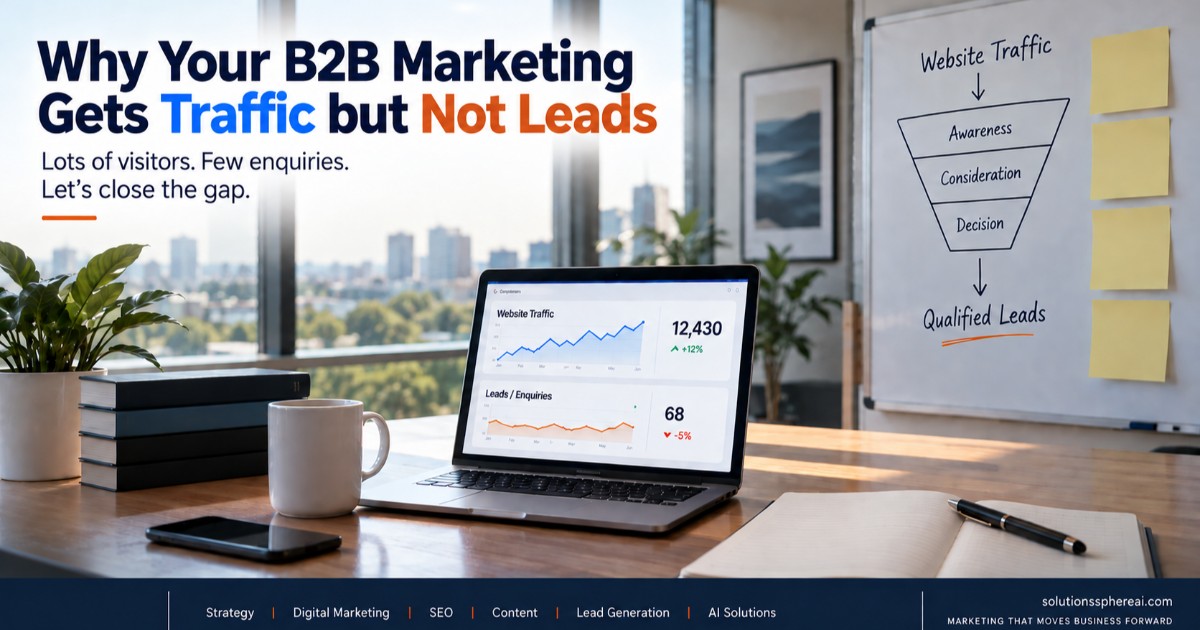
This is one of the most frustrating situations for B2B companies. On paper, marketing appears to be working. People are visiting the website, reading content and discovering the brand. Yet when the sales team checks the pipeline, there are very few qualified enquiries.
The problem is that website traffic and business demand are not the same thing.
A person searching “what is industrial automation” is not necessarily looking for an industrial automation provider. Someone searching “industrial automation companies in Bangalore” has a much stronger commercial reason. Someone searching for “industrial automation system integrator pricing” may already be comparing vendors. All three searches can generate traffic. Only some of those visitors are likely to become customers. That difference is where many B2B marketing strategies go wrong.
You May Be Attracting Visitors, Not Buyers
A common mistake in B2B SEO is focusing too heavily on traffic numbers. A keyword with 20,000 monthly searches can look far more attractive than one with 500 searches. But what happens if most of those 20,000 searches come from students, researchers, job seekers or people who simply want basic information? The smaller keyword could actually be worth much more if it attracts people who have a specific business problem and are actively looking for a solution.
This is why search intent matters more than search volume alone.
Your SEO strategy needs to account for these stages. Instead of building content around whatever keywords have the highest volume, identify the searches that indicate a genuine business requirement. Look for problem-based searches, solution searches, comparison searches and searches that include industry, location, application or technical requirements. That is where SEO starts contributing to lead generation rather than simply increasing website visits.
Your Content Could Be Helpful but Still Not Persuasive
There is another problem that is easy to miss. Your content may actually be good. It may explain the topic clearly. It may rank well. It may answer the reader's question. But it still might not give that reader a reason to choose your company. This happens when B2B content is written mainly to satisfy search engines instead of helping buyers make decisions.
For example, an article about industrial chillers could explain what a chiller is, how it works and list several benefits. There is nothing wrong with that. But a potential buyer may have much more practical questions.
Which type of chiller is appropriate for my process? What happens if the system is incorrectly sized? What operating factors affect energy consumption? What maintenance issues should I expect? How do I compare two suppliers? The strongest B2B content does not simply explain a product or service. It helps the buyer make a better decision. That is also where a company can demonstrate expertise without constantly talking about itself.
Your Website Might Be Losing the Leads Your Marketing Earned
Sometimes the problem is not your SEO or content at all. It is what happens after someone reaches your website. Imagine a potential customer finds your company through Google. They land on your service page and see phrases such as “innovative solutions,” “cutting-edge technology,” and “customer-focused approach.”
These statements sound professional, but they do not answer the questions the buyer actually has. What exactly do you provide? Who do you work with? What industries do you understand? What makes your approach different? Have you solved a similar problem before? What happens if I contact you? The more expensive or complex the purchase, the more important this becomes. A buyer considering an enterprise solution is unlikely to make a decision because a website simply says the company is “leading” or “innovative.” They want reasons to believe you can actually deliver.
“Contact Us” Is Not Always the Right Call to Action
Another reason B2B websites struggle to generate leads is that they expect every visitor to be ready to talk to sales. Someone reading their first article about a problem may not want a sales call. They may still be researching. If the only option available is “Contact Sales,” you are asking for a relatively high level of commitment from someone who may not be ready. Instead, give visitors different ways to continue their research.
An early-stage visitor might download a detailed industry guide. Someone comparing solutions could access a checklist or comparison guide. A visitor who is clearly evaluating suppliers might request a consultation, technical discussion or quotation. This creates a more natural journey. The goal isn't to turn every visitor into a lead immediately. It is to give qualified visitors a reason to stay connected until they are ready to buy.
Your Marketing Team May Be Measuring the Wrong Success
This is where things often become uncomfortable. Marketing teams can show impressive numbers: organic traffic is up, rankings have improved, social engagement has increased and content downloads are growing.
Then the sales team says, “We're still not getting enough good leads.” Both sides may be right. The problem is that marketing metrics and sales metrics are often disconnected.
Instead of asking only which blog received the most visitors, look at which content influenced enquiries. Which pages were visited before a prospect contacted the company? Which industries generated the best leads? Which keywords brought visitors who eventually became sales opportunities? This is a much better way of evaluating B2B content. A blog that attracts 500 highly relevant visitors and contributes to several qualified enquiries may be far more valuable than one attracting 20,000 visitors with almost no commercial intent.
Traffic is an input. Pipeline is the outcome.
B2B Buyers Are Doing More Research Before Talking to Sales The buying process has also changed. B2B buyers can now research companies, compare solutions, read technical content and evaluate alternatives without immediately speaking to a salesperson. Gartner reported that 61% of B2B buyers prefer an overall rep-free buying experience.
Research from 6sense also found that most buying groups had already established their vendor shortlist before engaging sellers. That means your marketing needs to do more than create awareness. It needs to help build preference. Your website should answer important questions before the sales call. Your blogs should address real problems. Your case studies should demonstrate results. Your comparison content should help buyers evaluate options. Your service pages should explain exactly where your expertise applies. If your company only appears when the buyer finally searches for a supplier, you may already be too late.
The Answer Isn't Simply “Get More Traffic”
If your B2B marketing is getting traffic but not leads, publishing more blogs is not necessarily the solution. First, look at who is visiting. Then look at why they are searching. Then examine what happens after they arrive. Are they finding content that matches their intent? Are your pages convincing enough? Is there evidence that your company understands their problem? Are there appropriate conversion options? Can sales identify which marketing activities are actually influencing opportunities?
These questions are far more useful than simply asking how to increase monthly website visitors. A strong B2B marketing strategy connects SEO, content, website experience and sales around the same objective: helping the right buyer move from problem recognition to consideration and eventually to a commercial conversa ion. When that happens, your website stops being a place that simply attracts visitors. It starts doing something much more valuable. It helps create customers.
The real goal of B2B marketing is therefore not to have more people visit your website. It is to make sure that when the right buyer starts looking for a solution, your company is visible, credible and relevant enough to make the shortlist. That is the difference between getting traffic and generating demand.
How Solutions Sphere AI Approaches B2B Marketing
At Solutions Sphere AI (SSAI), we believe B2B marketing should be measured by more than traffic and rankings. SSAI focuses on attracting the right audience, understanding search intent and creating content that helps potential buyers move closer to a decision.
By combining SEO, content marketing, AI-assisted strategies and conversion-focused marketing, SSAI helps businesses turn relevant website traffic into meaningful enquiries. The goal is simple: make your brand visible when buyers are searching, credible when they are evaluating options and easy to engage with when they are ready to take action.