

Why B2B Email Campaigns Are Ignored
When email campaigns are receiving low engagement, marketers often focus on improving the content. They experiment with subject lines, personalize the opening of emails, adjust call-to-action buttons and try out different sending times. But these changes will certainly help your campaign performance, they just won’t solve a deliverability issue.
Consider a company that sends 5,000 promotional emails to prospective business clients. The marketing team carefully prepares content, highlights their services and has a clear inquiry link. But a large number of those emails are winding up in the spam folders. Even if the messaging is relevant and professionally written, the campaign may seem to be a failure.
That’s why it’s important for businesses to differentiate between emails that reach the inbox but are not engaging and emails that don’t reach the inbox at all. The two problems require totally different solutions. Marketers could waste more time and money trying to improve campaigns that have a technical issue at their root if they don't understand this difference.
What Is Email Deliverability and Why Is It Important?
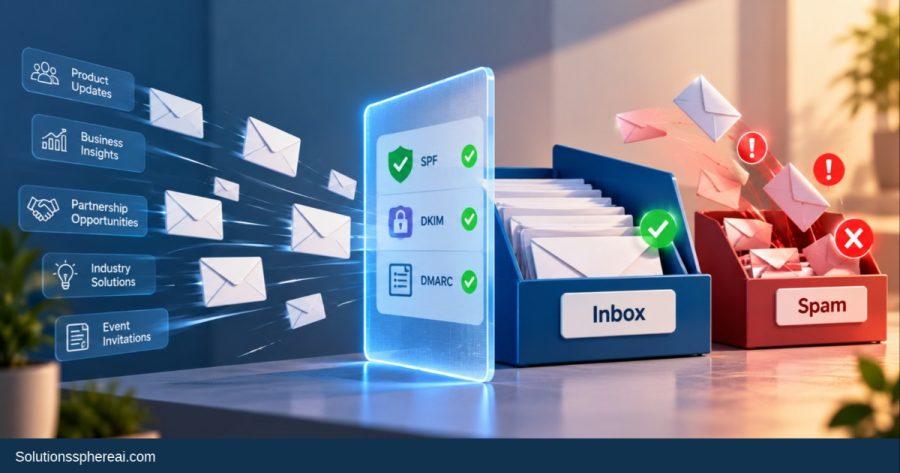
Email deliverability is the measure of how well an email gets to the recipient’s intended inbox. This is different from email delivery, which usually means that the receiving mail server has accepted the message. The server may send an email successfully, but it may still be marked as spam.
Gmail, Outlook, Yahoo and other email providers use a range of signals to judge whether a message is legitimate. These include sender reputation, domain authentication, sending behavior, recipient engagement and quality of content of email. If these signals are suspicious, email providers may filter or reject incoming messages.
This is particularly important for B2B companies that are communicating with corporate email addresses. Many companies have advanced email security systems that scan incoming messages before they ever arrive in employees’ inboxes. Even a legitimate marketing campaign can run into filtering problems if your sending domain has a bad reputation or incorrect authentication settings.
Good email deliverability means the content you’ve worked so hard to create, the audience you’ve researched, and the campaign you’ve planned have a better chance of reaching the intended audience.
Hidden Factors Impacting B2B Email Deliverability
Poor sender reputation is one of the biggest reasons marketing emails don’t land in inboxes. Email providers look at sending domain behavior over time. Spam complaints, high bounce rates, sending to invalid addresses and sudden increases in email volume can all damage this. Once a domain has a bad reputation, even the best-written emails might not make it to the inbox.
Another important thing is email authentication. Technical protocols like SPF (Sender Policy Framework), DKIM (DomainKeys Identified Mail) and DMARC (Domain-based Message Authentication, Reporting and Conformance) help receiving servers verify whether an email really comes from an authorized sender. SPF lists the servers allowed to send mail for a domain . DKIM uses a digital signature to verify the message is authentic . DMARC tells receiving servers what to do with messages that fail authentication . Without properly configured authentication, businesses are more at risk of spoofing and filtering.
Email list quality is just as important. Many B2B companies buy contact databases or use old prospect lists without regularly checking their accuracy. These databases might have dead addresses, stale employee information, duplicate contacts, and invalid email accounts. Sending campaigns to these lists will increase bounce rates and create unnecessary risks for the sender’s reputation. A small, well-cared-for list of relevant business contacts is often a more valuable asset than a massive database of unverified addresses.
Sending behavior also affects deliverability. A relatively new domain suddenly sending thousands of emails is the kind of behavior that can draw the wrong kind of attention from spam filters. The same promotion sent time and time again without regard to recipient preferences may lead to spam complaints. Trust is built over time by consistent sending patterns, relevant communication and responsible audience targeting.
How Poor Email Deliverability Is Hurting B2B Lead Generation
In B2B marketing, a single email can kickstart a valuable business conversation. It might introduce a company to a potential customer, get a decision maker to schedule an appointment, or reengage an inactive prospect in the sales funnel. When emails don’t reach their intended destination, these opportunities can disappear without the marketing team even knowing what hit them.
Poor deliverability can also result in misleading reports on campaigns. Low open rates may indicate the subject line isn’t working, while low click-through rates may indicate the content isn’t compelling enough. However, if a large percentage of emails are being filtered out, these metrics will not give you a complete picture of how your campaign is performing.
It can also affect the relationship between marketing and sales. Sales reps may end up with fewer qualified leads and marketing teams may find themselves scrambling to explain why campaigns aren’t delivering the desired results. Over time a business may try to compensate by sending more emails or adding more prospects to their lists which can actually exacerbate the underlying deliverability problem.
That’s why the performance of email should not be measured by open rates and clicks alone. You should also look at bounce rates, spam complaints, authentication results, inbox placement and domain reputation.
How to Improve B2B Email Deliverability in Practice
Email deliverability is a combination of technical setup, responsible sending practices and better audience management. “Businesses should start by looking at their SPF, DKIM and DMARC records to make sure their sending domains are properly authenticated. These configurations give receiving servers valuable data regarding the validity of incoming messages.
Next is maintaining a clean email database. Companies should regularly clean invalid addresses, suppress repeated hard bounces, identify inactive contacts, and avoid buying unverified email lists. Wherever possible, businesses should build their databases through real inquiries, website subscriptions, networking and relevant professional contact.
It is also worth noting how often you send. Instead of blasting out tons of emails without a plan, businesses should set up a regular sending rhythm and gradually increase their sending volume when using a new domain or email infrastructure. They have to avoid sending the same message to every contact. Messaging is more relevant when audiences are segmented by industry, company size, business needs, and where they are in the buying process.
Your email content should be clear, useful and transparent. Misleading subject lines, excessive promotional language, deceptive links, and unnecessary attachments can erode recipient trust. Every marketing email should have a clear purpose, tell the recipient what’s in it for them and make it easy to unsubscribe.
Finally, businesses should monitor deliverability regularly by using email platform reports, domain authentication checks, bounce reports, and reputable inbox placement testing tools. Marketers can track these indicators to detect problems before they damage big campaigns.
Why Email Deliverability Should Be Part Of Your B2B Marketing Strategy
Email deliverability isn't a technical problem that only IT teams need to understand. It is a key element of the overall B2B marketing strategy because it directly impacts how well businesses can communicate with potential customers.
A great email campaign takes more than a beautiful design and engaging copy. It requires a reliable sending infrastructure, a relevant audience, a trustworthy domain and a communication strategy respecting recipient preferences. By bringing these elements together, businesses can use email marketing to build stronger relationships and more meaningful opportunities.
Marketing teams should also be aware that deliverability isn’t a one-time activity. Requirements of email providers, domain reputation, audience behavior and sending practices may change over time. For consistent performance, regular monitoring and optimization are essential.
For companies investing in B2B lead generation, improving deliverability can help make existing marketing efforts more effective, without just increasing campaign volume. Businesses should focus on ensuring right emails reach right people instead of sending more emails.
Closing Thoughts
If no one is reading your B2B emails, it may not be your subject lines or your marketing message that’s the problem. It may be that your emails are having a hard time getting into the inbox at all. To identify what is holding your campaigns back, the first step is to understand the difference between email delivery and deliverability.
Every element, from domain authentication and sender reputation to email list hygiene and sending behavior, plays a role in how email providers evaluate your messages. By paying attention to these details, businesses can build more reliable email marketing systems, improve communication with prospects, and make better use of their marketing investments.
At SolutionsSphereAI (SSAI), we believe that B2B marketing is about getting the strategy right, building solid digital foundations, and creating meaningful conversations. As a B2B Digital Marketing Agency, SSAI helps businesses strengthen their digital presence, reach relevant audiences, and develop marketing strategies focused on sustainable growth. Businesses looking for a reliable B2B Digital Marketing Agency Bengaluru can explore how SSAI approaches digital marketing to support long-term business growth. The effective B2B marketing starts with the right strategy, strong digital foundations, and meaningful communication. As a B2B Digital Marketing Agency Bengaluru, SSAI helps businesses strengthen their digital presence and build marketing strategies focused on sustainable growth.