

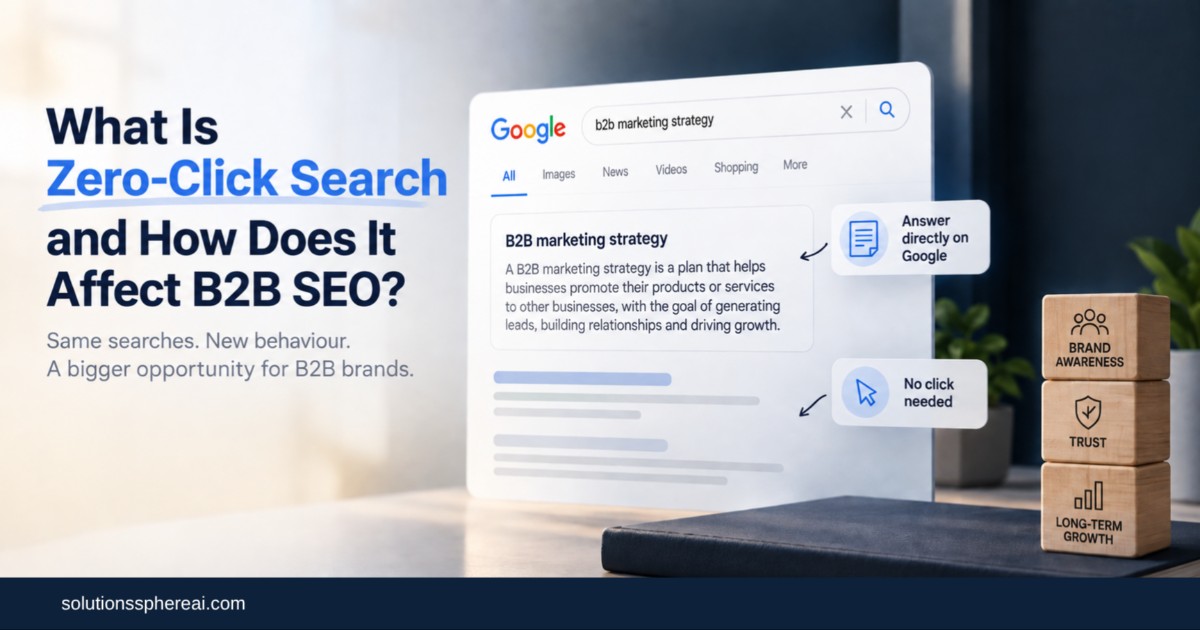
What is Zero-Click Search & How Does it Affect B2B SEO?
Consider the last time you searched for something on Google. There is a good chance you found the answer you were looking for without opening a single website. Maybe you looked up a word definition, a quick math problem, a company fact, or the answer to a basic question. Google probably showed the information at the very top of the results. You got what you needed and went on. This is called a zero click search.
It may seem like a small tweak in how people use search engines, but it has a much bigger impact on businesses than it appears. For years, SEO was basically about getting a website to the first page of Google and persuading people to click. So more clicks = more visitors. More visitors could = more leads and sales eventually. But search doesn’t work quite that way anymore. Search engines are starting to answer more questions directly, and AI is helping them fill in the answers. This raises an important question for B2B companies that depend on search to reach prospective customers: if people don’t always click, what does SEO success look like today?
What Is a Zero-Click Search?
A zero-click search is just what it sounds like. Someone searches for something and finds what they need right there in the search results and never goes to another site. It could be when somebody's looking for a definition, a calculation, a business location, a quick fact or an answer to a simple question.
Google can display these answers in featured snippets, People Also Ask, knowledge panels, maps and other search features. AI-powered search is doing this even better by summarizing information from different sources and giving users a more complete answer. This is convenient from the user’s point of view as they get an answer quickly. For businesses, however, it alters the traditional relationship between search rankings and website traffic.
Why zero-click search is important for B2B companies
This change is especially relevant for B2B companies, since B2B buying decisions rarely happen after one search. A potential customer will most likely start by Googling a problem they have, then research alternatives, compare approaches, read articles, look at case studies, and then start evaluating companies. At this stage, they may encounter your brand several times without having to visit your website every time. Think of a marketing manager seeking ways to enhance B2B lead generation. They find one of your articles while looking for lead generation strategies. A few days later, they find another article from your company, this time about marketing funnels. Later on, when they search for performance marketing, they find your brand again.
They may not have clicked every time, but they have seen your company over and over again. And then your brand is not a foreign entity to them when they finally need help with lead generation. This is one of the more insidious ways in which SEO can influence a B2B buyer. Search visibility can build familiarity well before they are a lead.
Is Zero-Click Search the Death of SEO?
Maybe not. The impact is largely dependent on what someone is searching for. Obviously, simple informational searches are more prone to zero-click results. If someone just wants to know what a term means, they may have no reason to visit a website after getting the answer from Google directly. But B2B search is a lot more broad than simple informational questions. The intent behind searching for “what is B2B SEO?” is different than someone searching for “B2B SEO agency” or “SEO services for SaaS companies.” The first person might be just learning and the second person might be actively researching a solution.
That’s why businesses need to look at search intent, instead of treating every keyword as the same. Some content should be to help people understand a topic. Some should prompt questions and raise awareness. Other content should be directed at people who are further down the decision process. These different types of content work best when combined in an SEO strategy.
The Problem With Creating Content Just for Keywords
One of the biggest changes in SEO is that companies can no longer solely rely on keywords. A keyword in a title and a few related phrases used several times in an article does not make the content valuable automatically. Usually people can tell when an article is written primarily to rank. If someone is searching for “B2B marketing strategy” then they probably don’t want to read a few paragraphs repeating what B2B marketing means. They want to know what actually works, what channels are effective, what to avoid, and how a strategy might apply to their business.
Here is where good content needs to be more than just the obvious answer. An article can quickly answer the main question, then provide examples, practical advice, common mistakes or useful context. The goal isn’t to write more words. The idea is to give the reader enough that it’s useful and they will want to keep reading. (Think Questions, Not Keyword.) Zero-click search also shifts how businesses should consider keyword research. Marketers need to understand the questions behind the search rather than starting with a list of keywords and trying to turn every keyword into a blog.
For example, “B2B lead generation.” If someone searches for that term they could be looking to understand how B2B lead generation works, what channels are effective, why their leads are not converting, whether paid advertising is the right choice or how content marketing can help with lead generation. They are different questions, but they all deal with the same general subject. Once you know the questions, it’s easier for businesses to create content that feels more useful and more relevant. One article may address a specific question, while other articles may discuss different aspects of the same topic. These articles can be strung together through time to create a much stronger content strategy.
The Significance of Topical Authority
This is where the importance of topical authority comes in. If you want your company to be known for B2B marketing, one article on B2B marketing is not enough. It should demonstrate knowledge of the wider subject. A company could develop content on B2B SEO, content marketing, lead generation, marketing funnels, performance marketing, conversion optimization, marketing automation, customer acquisition and other related topics. Then these articles can be interlinked so the reader can flow from topic to topic naturally. This is more than just a collection of individual blog posts. Then it is a useful asset in a given field of expertise. This can be especially useful for B2B companies, as prospective buyers often want to gain a proper understanding of a problem before they are ready to talk to a service provider.
How to Measure SEO Performance for Companies?
Zero-click search also makes it worthwhile to revisit the way businesses measure SEO. Website traffic is important, but it shouldn’t be the only number that counts. Search impressions, rankings, visibility, branded searches, engagement, qualified leads and conversions all offer a different view of performance. For example, imagine that an article gets thousands of impressions, but not as many clicks as you’d expect, because Google is answering part of the question directly. The article may look unsuccessful if you just look at traffic. But those impressions still mean thousands of people had the chance to see the company’s brand.
That doesn’t mean every impression will become a customer. It just goes to show that SEO can affect people even before they get to your website. In B2B marketing, where a purchase decision can take weeks, months, that early exposure can be valuable. Someone could find a company in an informational article today, and they could return to the website much later when they’re actually looking for a solution. For businesses that find it difficult to keep up with these changes, working with an experienced online marketing agency can help turn search data, user intent, and content strategy into a more focused approach to long-term organic visibility.
The future of B2B SEO
Zero-click search doesn't make SEO obsolete. It’s changing what businesses need to get out of SEO. The old way was pretty simple. Get a rank on Google, get the click, then try to get a lead. The modern search journey is more complex. A potential customer could see your brand in an AI generated answer, see a snippet of your website, see your content on LinkedIn, and then visit your website later and eventually contact your sales team. The journey may have many searches and many different touchpoints. That means businesses need to look past rankings and clicks. The bigger opportunity is to be a useful, recognizable source of information in the areas that matter to your target audience. Your brand can be slowly associated with the subject as prospective customers come across your content repeatedly while looking for a solution to a problem.# SEO Is Becoming More About Being the Answer
The question is no longer just, Was someone clicking on our website?” It is also, “Were we visible when our potential customer was looking for an answer?”
The difference matters for B2B companies. Search can introduce a brand, answer a potential customer’s questions, demonstrate you’re an expert, and keep your company top-of-mind through a long buying journey. Brands that recognize this shift may utilize SEO for more than a traffic channel.
At SolutionsSphereAI (SSAI), we see SEO as part of a larger digital marketing strategy. Search behavior is changing and businesses need to move away from just publishing content around keywords.
We at SSAI believe it’s about understanding user intent, creating genuinely useful content, building topical authority and connecting organic visibility with real business objectives. As AI continues to evolve the search experience, businesses committed to delivering value and becoming a trusted source of information will be better positioned to navigate the next phase of B2B search.