

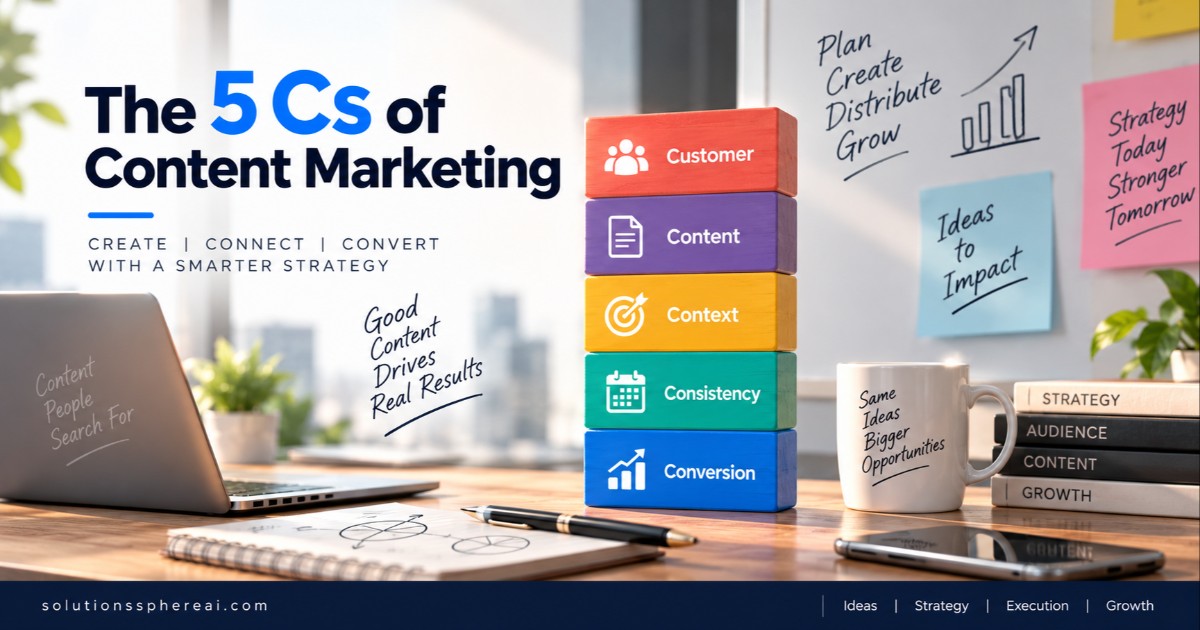
What Are the 5 Cs of Content Marketing?
The 5 Cs of content marketing are Customer, Content, Context, Consistency, and Conversion. Rather than seeing content as something a business needs to produce regardless, this concept encourages some extra thinking behind the process.
To begin with, identify your Customer and understand who this person is and what he or she needs. After that, think about the Content and ask yourself if it is interesting and helpful to people. Third, consider Context: Does the information correspond to the expectations of your particular customer?
Consistency implies being consistent without compromising the quality of the content. Lastly, Conversion is aimed at understanding what customers should do after reading/watching/downloading it.
These 5 aspects can be beneficial for nearly any business, particularly in cases of SEO content marketing, B2B marketing, social media, and lead generation.
1. Customer: Know Who You Are Talking To
The first C is Customer, and it is likely the best place to start. There is little sense in producing top-notch content if it is not useful to anyone.
Before starting a blog post or planning a social media campaign, businesses should spend some time analyzing their audiences and understanding who they are. What problems do these people have? What questions do they ask? What are they interested in? What doubts prevent them from making a purchase? The information can affect everything, from the choice of topic to its presentation style.
There are several ways for businesses to learn about their customers. Data on website analytics, search data, customer feedback, surveys, social media, and buyer personas can all help with that. In some cases, having a simple conversation with customers may be enough. It is especially useful in cases of SEO content marketing, because customers' searches say a lot about their current needs.
For example, someone who types "what is content marketing" is most likely looking for an explanation. The person who searches for "content marketing agency for B2B companies" is likely at a much more advanced stage and is already looking for a solution. The topics are similar but the intents are totally different, and good content distinguishes these two intentions.
2. Content: Give People a Reason to Read
The second C is Content. After you know your customer, the next step is to understand what you can do to help him or her. Good content should answer a question, solve a problem, explain something, provide valuable information, and help customers make decisions There are many formats that may be useful. When customers see that the information provided by the company is knowledgeable and practical, they start trusting it much more.
3. Context: Think About Timing
The third C is Context. Even a good piece of content is useless when it reaches the wrong customer at the wrong time. A person who has just found out about the problem is likely to ask different questions from someone who has already considered some solutions.
Think of the different stages of the customer journey. During the awareness stage, customers usually search for straightforward information. Blog posts, educational videos, social media content, and industry insights can help them understand the problem and explore possible solutions. At the consideration stage, they are more likely to seek for additional information. He or she may need pricing information, testimonials, demonstrations, consultations, or particular information on the products/services.
The channel also matters. Detailed B2B reports may be posted on LinkedIn or sent via email, while videos may be more relevant on social media. In general, context is about considering the current needs of the customer rather than thinking that the same content will be relevant to everyone.
4. Consistency: Keep Showing Up
The fourth C is Consistency. Creating content often takes time. A single excellent blog post does not mean that the next day a company gets hundreds of customers. The value usually lies in consistency. Content helps people become familiar with a brand, and over time, they recognize the brand and start seeing it as a source of valuable information. It does not mean that a business should produce content constantly. Quite the opposite – trying to create content all the time often compromises its quality.
Consistency implies having a realistic plan for posting. For example, one company posts 2 SEO blogs a month, shares several social media posts weekly, and sends newsletters monthly. The second company uses a completely different plan. The key is to find the frequency that fits the capacity of the team. Consistency also helps to establish brand authority. Seeing useful information from the same company again and again, the potential customers may gradually start perceiving it as an expert.
This aspect is especially useful when people are trying to choose among businesses offering the same products/services.
5. Conversion: What Happens Next?
The fifth C is Conversion. Reaching your customer, making him or her visit your blog, website, watch a video is nice. However, a business is likely to have some goals other than that. It does not necessarily mean that one has to sell anything to his/her customers at once. The conversion can include filling out a contact form, downloading an e-book, signing up for a newsletter, requesting a quote, booking a consultation, etc.
A call to action (CTA) can help in reaching that goal. A CTA tells customers what they can do next. For example, a blog post on digital marketing can encourage readers to contact a consultant. A B2B case study can make a potential customer request a consultation or product demonstration.
The CTA should correspond to the content and the state of the customer. When a person discovers the business just now, asking him or her to make a purchase may be too much. Giving a guide or a newsletter may be a more appropriate next step.
How the 5 Cs Work Together
All these 5 Cs become really useful when considered in connection with each other. Let's imagine a B2B company that wants to generate more leads through content marketing. To begin with, it analyzes the Customer. Who are the potential customers of the business? What problems do they have? What questions do they ask? Then the company creates Content corresponding to the identified needs. Rather than writing whatever becomes hot, the business focuses on topics useful to the audience.
Next comes Context. The customer who just started to research the problem may need a simple introduction. A customer who is comparing options may be more interested in a detailed guide, case study, or demonstration. The company also needs Consistency. Rather than posting whatever content becomes hot right now, the company posts regularly and consistently.
Finally, there is Conversion. Customers interested in the products or services of the company should be able to find an appropriate next step – downloading a guide, newsletter, contacting the sales department, etc. In this way, content marketing turns from a simple task for ticking a box on the list to something meaningful.
Why Are the 5 Cs Important?
Customers may conduct quite an extensive research before contacting any business. They can look for the information on Google, compare the options, read reviews, watch videos, read case studies, and participate in discussions in the industry. So, when someone decides to contact a company, he/she may already have a pretty good idea about what he/she wants and who the competitors are.
Thus, useful content becomes increasingly important. Instead of asking someone to buy something immediately, a company can use content marketing to answer questions, build trust, and show that the business understands the needs of the customer.
How SSAI CAN HELP
The 5 Cs of Content Marketing - Customer, Content, Context, Consistency, and Conversion provide a rather straightforward concept to approach content marketing strategy.
At Solutions Sphere AI, we understand content marketing not just as the process of posting articles on the blog and maintaining social media. Good content should have some goal. It should address a particular customer, help him or her with something, and build authority.
SSAI believes he combination of audience analysis, SEO, useful content, consistency, and conversion helps turn content marketing into a valuable asset that attracts attention, builds trust, and supports the business development.
Whenever your goals are, we at SSAI will help improve the online presence of your business, generate more leads, establish authority in the industry and create a strong online presence.
Related Articles
- Digital Marketing Trends in India 2026
- Why Your Business Is Not Showing Up on Google
- How To Turn Social Media Followers Into Customers